By Pacific Heating & Cooling | NATE-Certified Service Technicians | Updated September 2026
Your furnace has started making a rattling, buzzing, or grinding sound that was not there before, and you want to know what it means before you decide whether to call someone. Rattling is usually a loose panel or a blower wheel that has come loose, buzzing or humming often points to an electrical part like a transformer or capacitor, and grinding or squealing almost always means a motor bearing is wearing out. Here is what causes each sound, what is safe to check yourself, and what furnace noise repair typically costs across Tacoma and the South Sound.
The most common causes of furnace noise
Rattling, buzzing, and grinding come from different parts of the system, so the sound itself is usually the fastest clue to what is wrong. In our service records, rattling and banging point to something loose, buzzing or humming points to an electrical component, and grinding or squealing points to a motor bearing that is wearing down.
Rattling or banging
Rattling and banging are almost always caused by something loose, not something broken. It could be an access panel that was not seated all the way, a blower wheel that has shifted slightly, or ductwork expanding as it heats up.
Homeowners usually notice the sound right when the furnace kicks on or shuts off, and it often repeats every single cycle. A rattle that only happens once in a while is less concerning than one that shows up every time the system runs.
A technician’s first step is finding exactly where the sound is coming from, since a loose panel and a loose blower wheel sound similar but need very different fixes. Once the source is confirmed, most panel and mounting issues are tightened and resolved the same visit.
Example From a Recent Service Visit
A homeowner in Tacoma called after hearing a strange rattling sound every time the furnace kicked on, always around 4:30 in the morning. The rattling lasted about 15 minutes before stopping completely, which made it hard to catch during a daytime visit.
Solution: We inspected the blower compartment and access panels for the exact vibration the homeowner described, tightened the panel that was the source, and confirmed the system ran quietly through several start-up cycles before we left.
One cause of banging we take more seriously is a cracked heat exchanger, which can create a distinct popping or rattling sound as the metal expands. This is not something to wait on. If you hear a metallic banging along with a burning smell or notice soot near the furnace, turn the system off and call for a diagnostic right away.
Buzzing or humming
Buzzing and humming are usually electrical. A transformer, a run capacitor, a relay, or the blower motor trying and failing to start can all create a steady hum or buzz near the furnace cabinet.
This sound is easy to notice because it is constant rather than a single knock or bang. It often shows up right at startup and continues as long as the furnace is running, sometimes paired with a flashing status light on the control board.
A technician checks the electrical components in order, starting with the transformer and capacitor before moving to the control board, since replacing the wrong part first just adds cost without solving anything. Pacific’s NATE-certified technicians walk you through exactly what they find before recommending a repair.
Randy in Auburn put it this way:
“Thank you for sending Brandon and Matt to inspect my furnace.”
Randy in Auburn
Furnace calls like this one are common in Auburn, Tacoma, and Puyallup, where dispatcher notes describe everything from a blower motor “making a loud noise and hot” to a furnace humming along with a flashing light on the control board. Both point to an electrical or motor issue rather than something loose.
Grinding or squealing
Grinding and squealing point to a motor bearing wearing out, either in the blower motor or the inducer motor that pulls exhaust through the furnace. This is the sound most likely to get worse quickly, since a bearing does not repair itself once it starts to fail.
Homeowners often describe it as a metal-on-metal sound or a high-pitched squeal that gets louder the longer the furnace runs. If the grinding is coming from the inducer motor specifically, you may also notice the furnace struggling to start or shutting off on an error code. We cover that failure in detail in our guide to furnace inducer motor failure.
The common solution is replacing the failing motor before the bearing seizes completely, since a seized motor can take out other components and turn a straightforward repair into a bigger one. Most motor replacements are completed the same day once the correct part is confirmed.
What a homeowner can do vs. what requires a technician
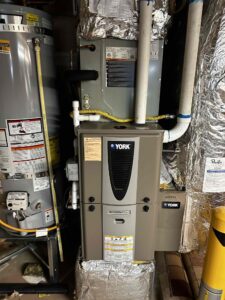
A properly maintained furnace with its door panel intact and labeling visible.
What you can safely check yourself:
- Replace the air filter if it has not been changed recently. A clogged filter forces the blower motor to work harder, which can sound like a strain or a mild buzz.
- Make sure nothing is resting against the furnace cabinet or blocking nearby vents and registers.
- Note when the noise happens (startup, shutdown, or the whole cycle) and roughly how long it lasts. That detail helps a technician diagnose it faster.
- If you smell gas or burning, or the noise is paired with smoke, turn the system off at the switch and call right away rather than investigating further.
What requires a technician:
Opening the furnace cabinet to inspect the blower wheel, motor bearings, capacitor, or control board involves electrical components and moving parts that are not safe to work on without training. A technician also has the tools to test electrical components directly instead of guessing based on the sound alone. During a diagnostic visit, we check the full system, not just the noise you called about, so you are not back on the phone a week later for something we could have caught the first time.
Signs you should call for furnace repair
- Grinding or squealing that gets louder each time the furnace runs.
- Any burning smell, smoke, or metallic odor along with the noise.
- The furnace shuts off on its own shortly after the noise starts.
- A flashing error light on the furnace or thermostat appears with the sound.
- The noise happens every cycle, not just once in a while.
- The noise started right after a repair or tune-up and was not there before.
If you notice any of these, it is time to schedule a furnace repair visit rather than waiting to see if it goes away.
What does furnace noise repair cost in Tacoma and Western Washington?
Based on 265 furnace service calls in our records that mention rattling, buzzing, or grinding sounds, invoiced totals range from $86 for a diagnostic-only visit to just over $5,000 for the most involved repair we tracked, a full heat exchanger replacement. Most calls land between $99 and $429, which covers the diagnostic fee plus a common part replacement like a capacitor, blower motor, or control board.
What drives the spread is almost always the part involved. A capacitor or transformer is a lower-cost fix, a blower motor or inducer motor replacement sits in the middle of the range, and a control board or heat exchanger repair costs more because of the part itself and the labor involved. Club members receive a reduced diagnostic fee, which is one reason the low end of the range is where it is.
We see these calls most often in Tacoma, Puyallup, Lakewood, Kent, Gig Harbor, and Auburn, which lines up with where Pacific has served homeowners since 1984. Most repairs are completed the same day.
Celia in Gig Harbor put it this way:
“Treated with respect from phone call to diagnostic. Technician was thorough and provided the information needed.”
Celia in Gig Harbor
If the diagnostic uncovers something bigger than a simple repair, like a cracked heat exchanger on an older furnace, we will walk you through whether repair or replacement makes more financial sense. Our guide to furnace repair vs. replacement covers that decision in more detail, and we back every repair with our 100% money-back guarantee. Pacific’s Peace of Mind Club members also get priority scheduling if the noise turns into a no-heat situation.
This is one of several furnace issues we cover in detail. For a broader look at what else can go wrong, see our guide to common furnace problems.
Frequently Asked Questions
-
-
-
-
It depends on the sound and what is causing it. A faint rattle from a loose panel is usually not urgent, but grinding, a strong burning smell, or the furnace shutting off on its own means you should turn the system off and call for a diagnostic. When in doubt, it is safer to turn the furnace off and have it checked before running it again.
-
-
You can safely check a few things yourself, like replacing a dirty air filter or making sure nothing is resting against the cabinet. Opening the furnace to tighten internal parts or work on the blower motor is not something to do yourself, since it involves electrical components and moving parts. A technician can pinpoint the exact source in one visit instead of you guessing.
-
-
A noise that only happens at startup usually points to the blower motor or inducer motor working harder to get moving, which is common when a bearing is starting to wear. It can also mean a belt or wheel is slightly loose and settles once it is up to speed. Either way, a startup noise that repeats every cycle is worth having checked.
-
-
Grinding almost always means a motor bearing, either in the blower motor or the inducer motor, is wearing out. This kind of noise typically gets louder over time and does not go away on its own. Replacing the motor before it fails completely usually costs less than an emergency call after it stops working.
-
-
A humming or buzzing sound by itself is usually electrical, coming from a transformer, capacitor, or relay, and is not automatically a fire risk. That said, any burning smell, sparking, or a breaker that keeps tripping along with the noise means you should turn the system off and call right away. Most buzzing furnace calls we get are a straightforward part replacement.
Still not sure what’s causing the problem?
Tell us what your system is doing and we’ll help you figure out the right next step. Pacific Heating & Cooling has been diagnosing heating and cooling problems across Tacoma and the South Sound since 1984. NATE-certified technicians, 2-hour arrival windows, and upfront pricing before any work begins.