Your furnace is making a sound, a hum, a rattle, maybe nothing at all, and no heat is coming out. If you have a gas furnace, there’s a good chance the problem starts with one part: the inducer motor. It’s not a part most homeowners have heard of, but it’s the one our technicians replace more than almost any other. This post explains what it does, why it fails, what it costs to fix, and how to know when to call.
What the inducer motor does — and why it matters
Before your furnace can fire, it has to prove it’s safe to do so. The inducer motor is the part that starts that process. It spins up first, pulling combustion gases through the heat exchanger and out the flue. Once it’s running and pressure builds, a pressure switch confirms the airflow is clear. Only then does the ignitor glow and the burners fire.
That sequence — inducer on, pressure confirmed, ignition — happens every time your furnace calls for heat. When the inducer motor fails, the sequence stops at step one. No airflow confirmation, no ignition, no heat.
That’s why inducer motor failure almost always means a complete no-heat situation, not just reduced performance. The furnace won’t partially heat your home. It simply won’t start.
The most common causes of inducer motor failure — and what to do about each
Age and bearing wear
The inducer motor runs every heating cycle, every day, for years. The bearings that keep it spinning wear down over time. When they start to go, you’ll often hear it — a high-pitched whine, a grinding noise, or a loud rattle coming from the furnace before it shuts down.
In our service records from this heating season, the median age of a furnace at inducer motor failure is 15 years. That doesn’t mean every 15-year-old furnace will have this problem — but if your system is in that range and you’re hearing unusual sounds, this is worth getting looked at before it fails completely.
On a furnace under 12 years old, replacing the inducer motor is almost always the right call. At 15 years and above, it’s worth running the numbers on the full system.
Example From a Recent Service Visit
A homeowner in Tacoma called us in December after her furnace stopped starting. Our technician found the inducer motor pulling high amps and producing a loud whine — both signs of bearing failure. The motor was replaced, the system was cycled for 15 minutes to confirm stable operation, and we found one additional issue: flame rollout at the burner box that suggested the collector box had a slow leak. We documented the findings and walked the homeowner through what to watch for on an older system.
Solution: We replaced the inducer motor and seal, completed a full heating tune-up, and provided written documentation of the additional findings for the homeowner’s records.
Moisture and condensation damage
High-efficiency furnaces produce condensation as a byproduct of combustion. That moisture is supposed to drain away through the condensate system. When it doesn’t — because of a clogged drain, a cracked collector box, or a failed condensate pump — water can back up and reach the inducer motor.
Water and electric motors don’t mix. Moisture in the motor housing accelerates corrosion, degrades the windings, and shortens the motor’s life significantly. In the Pacific Northwest, where we run furnaces through long wet winters, this is a more common failure path than in drier climates.
If our technician finds a failed inducer motor with signs of water damage, we’ll always look upstream for the moisture source — because replacing the motor without fixing the drain problem just means the next motor fails too.
Electrical failure — windings and wiring
Sometimes the motor itself is intact but the electrical components have failed. The windings inside the motor can burn out, especially if the motor has been running under strain from a failing bearing or restricted airflow. A technician will test the winding resistance with a multimeter — if the readings are uneven or out of range, the motor needs to be replaced.
Wiring connections between the control board and the inducer motor can also loosen or corrode over time, causing intermittent failures. The furnace might start some of the time, fail others, with no obvious pattern. Intermittent inducer problems are one of the harder diagnostics because the failure isn’t always present when the tech arrives — which is why we cycle the system multiple times during a diagnostic call, not just once.
When the inducer motor and pressure switch fail together
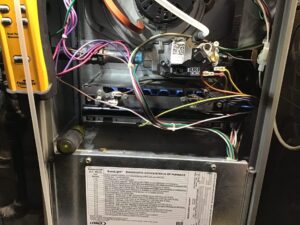
A Pacific Heating & Cooling technician diagnosing a Lennox furnace — the SureLight diagnostic code chart lists the pressure switch errors that often accompany inducer motor failure.
Here’s something worth understanding if you’re looking at an error code on your thermostat: inducer motor failure and pressure switch errors almost always appear together. That’s not a coincidence — it’s a cascade.
The pressure switch is a safety device that monitors whether the inducer is actually moving air. If the inducer motor fails or runs too slowly, the pressure switch never confirms airflow and throws an error. So the thermostat shows a pressure switch fault, but the pressure switch itself is often fine — the inducer motor upstream of it is the real problem.
This is one of the reasons we don’t replace parts based on error codes alone. We diagnose the full sequence before recommending a repair.
What a homeowner can check — and what requires a technician
What you can do before calling
- Check your filter. A severely clogged filter restricts airflow enough to cause the inducer motor to run harder and overheat. Check it first — it takes 30 seconds and costs nothing.
- Listen before the furnace shuts down. Note whether you hear a hum, a grinding noise, or silence. This helps your technician narrow the diagnosis before they arrive.
- Note the error code. Most modern thermostats or furnace control boards display a fault code. Write it down or photograph it — it tells the technician which part of the startup sequence failed.
- Check the condensate drain. If your furnace has a condensate pump or drain line, verify it isn’t blocked or full. A tripped safety float can shut down the entire system and is sometimes mistaken for an inducer failure.
What requires a technician
Everything beyond those checks. Testing the inducer motor properly means verifying voltage input, measuring amp draw, ohming out the windings, checking the pressure switch independently, and cycling the system under load — not just once, but multiple times to catch intermittent failures. That requires tools, training, and access to the furnace internals.
Attempting to run the furnace while bypassing safety switches — something some online guides suggest — creates a real risk of carbon monoxide entering the living space. The inducer motor exists precisely to ensure combustion gases move safely out of the home. Don’t bypass the system that controls it.
Signs you should call for furnace repair
- Your furnace attempts to start, you hear a hum or rattle, and then it shuts off
- Your thermostat shows a pressure switch error code
- Your furnace worked yesterday and produces no heat today
- You hear a high-pitched whine from the furnace before or during the heating cycle
- The furnace starts intermittently — works sometimes, fails others, with no clear pattern
- Your furnace is 15 or more years old and has started showing any of the above symptoms
If your furnace has completely stopped producing heat, don’t wait. January is our busiest month for inducer motor calls — and in a South Sound winter, a night without heat is a real problem. We offer same-day service and our pricing is flat-rate, so you’ll know the cost before any work begins.
★★★★★ (5/5)
“Anthony was quick to respond to my ‘no heat dilemma’ and got the furnace up and running within an hour. This service occurred on a Saturday evening when other companies wanted to charge an expensive emergency price of $400.00. Pacific Heating and Cooling only charged $119.00 for the service call.”
Google Review — January 2026
What does inducer motor replacement cost?
Based on our service records from this heating season, inducer motor replacement in the South Sound typically runs $317 to $1,245, with a median cost of around $908. The range reflects differences in motor type, system age, and whether additional parts are needed at the same visit.
The repair cost needs to be weighed against the age and condition of the full system. On a furnace under 12 years old, replacing the inducer motor is usually a clear decision. On a system 15 years or older — especially if our technician finds additional wear on the heat exchanger, blower motor, or control board — we’ll walk you through the math on replacement before you commit to a repair.
Of all the diagnostic calls our technicians ran last heating season, 87% ended in a repair. Only 13% led to a full system replacement. We’ll tell you honestly which category your situation falls into.
Schedule a furnace diagnostic in the South Sound
Pacific Heating & Cooling has been diagnosing and repairing furnaces across Tacoma, Puyallup, Gig Harbor, Lakewood, and the South Sound since 1984. We offer same-day service, flat-rate pricing, and a straightforward answer on whether repair or replacement makes more sense for your system.
Club members receive priority scheduling and same-day dispatch. Learn more about Club membership →
Contact Us
Frequently asked questions about inducer motor failure
What are the signs of a failing inducer motor?
The most common signs are a high-pitched whine or grinding noise before the furnace shuts down, a humming sound followed by no heat, a pressure switch error code on your thermostat, or intermittent heating where the furnace works sometimes but fails others. If your furnace is 15 or more years old and showing any of these symptoms, the inducer motor is the most likely cause.
How much does inducer motor replacement cost?
Based on our service records from the 2025–2026 heating season, inducer motor replacement in the South Sound typically runs $317 to $1,245, with a median cost of around $908. The range reflects differences in motor type, system age, and whether additional parts are needed at the same visit.
Why does my thermostat show a pressure switch error when the inducer motor fails?
The pressure switch monitors whether the inducer is actually moving air before allowing ignition. When the inducer motor fails, the pressure switch never confirms airflow and throws a fault code. The thermostat shows a pressure switch error, but the pressure switch itself is often fine — the inducer motor upstream of it is the real problem.
How old is a furnace when the inducer motor typically fails?
Based on our service records, the median age at inducer motor failure is 15 years, across 752 recorded cases. On a furnace under 12 years old, replacing the motor is almost always the right call. At 15 years and above, it is worth evaluating whether full system replacement makes more financial sense.
Should I repair or replace my furnace if the inducer motor fails?
Of all the diagnostic calls we ran last heating season, 87% ended in a repair and only 13% led to a full system replacement. On a furnace under 12 years old, repair is almost always the right decision. On a system 15 years or older — especially if the technician also finds wear on the heat exchanger, blower motor, or control board — replacement may be more cost-effective. We will walk you through the math for your specific system.
Can I fix an inducer motor myself?
Homeowners can check the filter, note any sounds before shutdown, photograph the error code, and verify the condensate drain is clear. Beyond that, proper diagnosis requires testing voltage, measuring amp draw, ohming out the motor windings, and cycling the system multiple times under load. Attempting to bypass furnace safety switches creates a real carbon monoxide risk. Inducer motor diagnosis and replacement should be performed by a licensed HVAC technician.
Related: Furnace Repair in Tacoma · Repair or Replace Your Furnace · Common Furnace Problems