By Pacific Heating & Cooling | NATE-Certified Service Technicians | Updated April 2026
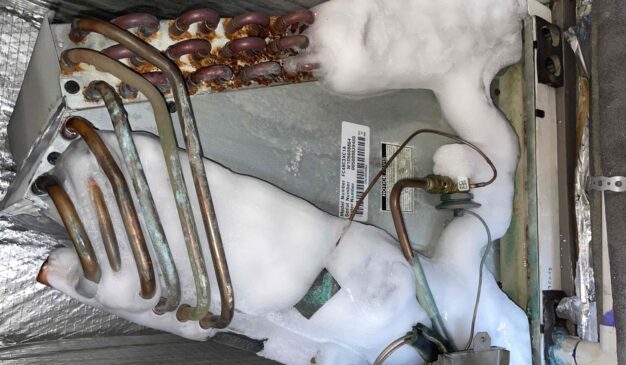
If your AC is running, the outdoor unit sounds normal, and the house is still climbing toward 80 degrees, check the copper lines running into the indoor air handler. Ice or frost on those lines means your evaporator coil is frozen, and in nearly every summer case we see across Tacoma and the South Sound, one of three things is behind it: a clogged air filter restricting airflow, low refrigerant from a leak, or a weak blower fan motor. The fix is often simpler than homeowners expect, but running a frozen system longer can turn a same-day repair into compressor damage.
Here is what causes it, what to do the moment you notice ice, and what frozen AC coil repair typically costs in Western Washington.
What causes a frozen AC coil?
A frozen AC coil in summer is almost always caused by one of three problems: restricted airflow from a dirty filter or blocked ducts, low refrigerant from a leak, or a blower motor that is no longer moving enough air. Across 258 summer diagnostic visits in our service records where technician notes flagged ice, frost, or a freeze, the cause traced back to one of those three every time. Each one cools the coil below 32 degrees, and each one requires a different fix.
1. Restricted airflow from a clogged filter or blocked vents
This is the cause we see most often, and it is the cheapest to fix. A dirty air filter, a collapsed return duct, or closed and blocked supply vents all cut the airflow the coil needs to pull heat out of the home. When warm air stops moving across the coil, the refrigerant inside has nothing to absorb heat from, and the coil temperature drops below 32 degrees.
How to recognize it: weak airflow at the vents, a filter that looks dark gray when you hold it up to light, the system running nonstop without the house cooling down. This is the cause that most often shows up on systems that have not had a filter change in six months or more.
Common solution: replace the filter, inspect the return ducting for a collapsed or disconnected section, and let the coil thaw fully before testing the system. If the coil has been running frozen for several days, we also check the blower motor for strain damage and confirm refrigerant pressures are still correct.
Example From a Recent Service Visit
A homeowner in Tacoma called on a Monday after noticing the house had climbed to 82 degrees over the weekend with the thermostat set to 72. The outdoor unit was running and sounded normal, but no cool air was reaching the vents. Our technician found ice fully wrapped around the indoor coil and the suction line, and a filter that had not been changed in over a year.
Solution: We switched the system to fan-only mode to thaw the coil, replaced the filter, and checked refrigerant pressures once the coil cleared. Pressures tested clean, so no refrigerant work was needed. Cooling was restored that same afternoon, and we walked the homeowner through a filter schedule to keep it from happening again.
2. Low refrigerant from a leak
When refrigerant charge drops below the manufacturer spec, pressure inside the coil falls and the refrigerant temperature falls with it. Once it drops below 32 degrees, humidity on the coil freezes. Unlike a filter issue, low refrigerant does not correct itself, and adding more without finding the leak just buys a few weeks before the coil freezes again.
How to recognize it: cooling that has gotten weaker across the season, a hissing or bubbling sound near the indoor unit, higher utility bills, and ice specifically on the thick copper line running from the outdoor to the indoor unit.
Common solution: a proper leak search, often with nitrogen pressure testing when the leak is not visible, followed by repair of the leak and a recharge to factory spec. You can find a full breakdown of leak repair costs and what drives them in our guide to AC refrigerant leak repair cost.
3. A failing blower fan motor or dirty blower wheel
Even with a clean filter, the coil will freeze if the indoor blower is not moving enough air. A weak blower motor, a dirty blower wheel packed with dust, or a failed capacitor on the motor itself can all reduce airflow below what the coil needs.
How to recognize it: very weak airflow at the vents even right after a filter change, a humming or buzzing sound from the indoor air handler, or a system that used to cool fine but has slowly gotten weaker over a season or two.
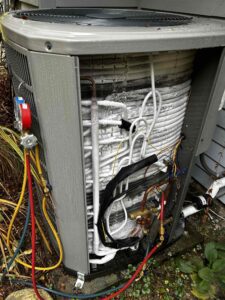
A completely frozen condenser coil found during a service call. Ice buildup like this points to low refrigerant, restricted airflow, or both. Pacific Heating & Cooling technicians diagnose the root cause before any repair begins.
Common solution: inspection of the blower motor amp draw, the motor capacitor, and the blower wheel. Depending on what the technician finds, the fix is either a cleaning, a capacitor replacement, or a motor replacement.
What should you do right now if your AC coil is frozen?
The moment you see ice, switch the thermostat to OFF for cooling and set the fan to ON. That stops the freeze from getting worse, protects the compressor, and starts thawing the coil so a technician can properly diagnose the cause. A full thaw usually takes 2 to 4 hours. Do not use a heat gun, hair dryer, or boiling water to speed it up.
What you can safely do
- Switch the thermostat to OFF for cooling, then set the fan to ON. This circulates room-temperature air across the coil and thaws it safely over 2 to 4 hours.
- Check and replace the air filter. If the filter is visibly dirty, that is very likely your cause. Put in a fresh filter before restarting the system.
- Open every supply vent and clear anything blocking returns. Furniture against a return grille is a common culprit.
- Place towels around the air handler if water is dripping. A heavy thaw can overflow the condensate drain pan.
What requires a technician
Refrigerant handling is regulated by the EPA, so if the cause is a leak, that part of the repair needs a certified technician. Blower motor and capacitor work involves high-voltage components and should also be left to a professional. Once the coil is thawed and the filter is fresh, if cooling still fails or the coil freezes again within a day or two, it is time for a diagnostic. We pressure-test the refrigerant, check blower motor performance, and confirm the charge so you know exactly what is happening inside the system. No guesswork. No pressure. Just straightforward solutions.
Signs you should call for frozen AC coil repair
- You see visible ice or frost on the copper refrigerant lines or the indoor coil
- The system is running, the outdoor unit is spinning, but no cool air comes from the vents
- The coil thaws but freezes again within 24 to 48 hours even with a clean filter
- Water is pooling around the indoor air handler as melted ice overflows the drain pan
- You hear hissing or bubbling from the indoor unit, which can indicate a refrigerant leak
- Cooling has gotten progressively weaker across the season, even with regular filter changes
If you are seeing any of these, book a diagnostic. Running a frozen system longer stresses the compressor, and compressor damage is one of the most expensive repairs on an AC or heat pump.
What does frozen AC coil repair cost in Tacoma?
Across 100+ completed frozen coil repairs last summer across Tacoma, Gig Harbor, Lakewood, Puyallup, and the broader South Sound, costs ranged from $155 to $1500+. The spread depends entirely on the cause and additional repairs needed
Many customers choose to let the coil thaw on their own before moving forward. In those cases, the visit is a diagnostic fee to identify the cause, and the actual repair is scheduled separately once the coil is clear. If you would rather have us remove the ice during the visit so the technician can diagnose and begin repairs the same day, that typically adds $350 to $750 to the visit. Most repairs are completed the same day.
Here is what drives the cost range:
| Cause | Typical repair range |
|---|---|
| Airflow fix (filter, duct inspection) | Diagnostic fee plus the cost of a new filter |
| Blower motor capacitor replacement | $200 to $400 typical |
| Refrigerant leak repair and recharge | $300 to $1,500 depending on leak location and refrigerant type |
| Blower motor replacement | $600 to $1,200 depending on motor type |
| Compressor damage from prolonged freeze | $1,500 and up; often a repair-vs-replace conversation |
Here is what Ilene in Olympia had to say about a recent diagnostic visit:
“Kyle was great! Very thorough and explained what he was checking and why. Reviewed system settings etc. He couldn’t find anything specific that was causing the problem but we changed a few settings and it’s working ok now. All your techs are friendly and helpful and very good at communicating and answering questions.”
Ilene in Olympia
Every diagnostic starts with upfront pricing before any work begins. You will see what we are seeing and know what it means. Our cooling repair service is backed by our 100% Money-Back Guarantee, and regular cooling maintenance is the best way to catch airflow and refrigerant issues before they freeze the coil in the middle of a heat wave. Our Peace of Mind Club members get priority scheduling during peak summer demand, plus annual tune-ups that catch low refrigerant and airflow issues before they turn into a no-cool call.
For the bigger picture on cooling problems, our guide to why your AC is not cooling walks through every common cause, with links to the specific repair details for each one.
Frequenty Asked Questions
-
-
Most frozen AC coils take 2 to 4 hours to thaw fully when you switch the thermostat to fan-only mode. Heavy ice buildup from a system that has been running frozen for several days can take up to 6 hours. Never speed up the thaw with a heat gun, hair dryer, or boiling water. The coil fins bend easily and forced heat can damage electrical components.
-
-
No. Refrigerant handling is regulated by the EPA and requires certification. More importantly, adding refrigerant without finding the leak just masks the problem for a few weeks before the coil freezes again. A proper repair includes locating the leak, often with nitrogen pressure testing, fixing it, and recharging to factory spec so the fix actually lasts.
-
-
Not always, but it should be handled the same day you notice it. The urgent part is switching the thermostat to OFF for cooling and the fan to ON so ice does not keep building. Running a system with a frozen coil can damage the compressor, and compressor replacement is one of the most expensive AC repairs. Once the coil is thawed and the filter is fresh, booking a diagnostic within 24 to 48 hours is usually soon enough.
-
-
Across 100+ completed frozen coil repairs last summer across Tacoma, Gig Harbor, Lakewood, Puyallup, and the broader South Sound, costs ranged from $155 to $1500+. The spread depends entirely on the cause and additional repairs needed
Many customers choose to let the coil thaw on their own before moving forward. In those cases, the visit is a diagnostic fee to identify the cause, and the actual repair is scheduled separately once the coil is clear. If you would rather have us remove the ice during the visit so the technician can diagnose and begin repairs the same day, that typically adds $350 to $750 to the visit. Most repairs are completed the same day.
-
-
If a clean filter does not solve it, the cause is usually low refrigerant from a small leak or a blower motor that is not moving enough air. Both issues reduce the rate of heat transfer across the coil and let the refrigerant drop below freezing. A technician will pressure-test the system, check blower amp draw, and confirm the charge so you know which of the two is the actual cause.
-
-
Yes, if you run it long enough. The compressor can overheat when refrigerant cannot flow properly through an iced coil, and the blower motor strains against blocked airflow. Both components are expensive to replace. The moment you see ice, switch the thermostat to OFF for cooling and set the fan to ON to stop damage before it starts.
-
-
Regular maintenance catches the two most common causes of frozen coils before they happen. During a Precision Tune-Up, we check refrigerant charge, test blower motor performance, and inspect the filter and airflow. Catching a small refrigerant drop in spring prevents a no-cool call in July. Peace of Mind Club members get these tune-ups annually plus priority scheduling during peak summer demand.
Still not sure what's causing the problem?
Tell us what your system is doing and we’ll help you figure out the right next step. Pacific Heating & Cooling has been diagnosing heating and cooling problems across Tacoma and the South Sound since 1984. NATE-certified technicians, 2-hour arrival windows, and upfront pricing before any work begins.