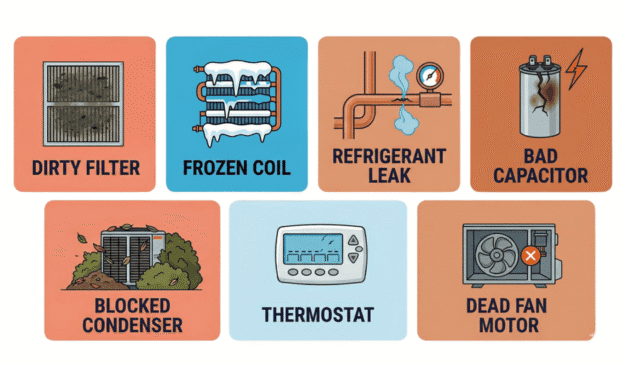
Your AC is running. You can hear it. You can feel air coming through the vents. But your house is still warm, and it keeps getting warmer. The seven most common reasons this happens are a clogged air filter, a refrigerant leak, a frozen evaporator coil, a failed capacitor, a thermostat issue, a dirty or blocked outdoor condenser unit, or a failing compressor. Some of these are simple enough for a homeowner to check before calling anyone. Others need a trained technician with the right tools to diagnose and repair safely. This guide covers what each cause looks like, what to do first, and when it is time to call for a diagnostic.
The 7 most common reasons your AC is not cooling
1. Clogged air filter
A severely dirty air filter is the single most common reason an AC system underperforms. When airflow through the filter is restricted, the system cannot pull enough warm air across the coil to cool your home. In some cases it causes the coil to ice up entirely, which makes things worse. Check your filter first. If it looks grey and matted rather than white, replace it before calling anyone.
Filters should be replaced every one to three months depending on your home. Homes with pets or high dust levels need more frequent changes. Across our service records, filter issues appear in a significant portion of cooling diagnostic calls, and many are resolved without any further repair once airflow is restored.
2. Refrigerant leak
Refrigerant is the fluid that moves heat out of your home. When the system loses refrigerant through a leak, it loses the ability to cool effectively. The most recognizable signs are warm air from vents despite the system running, ice or frost on the copper refrigerant lines, and energy bills that have gone up without explanation. A refrigerant leak does not resolve on its own. Running the system low on refrigerant also puts stress on the compressor over time.
Only EPA-certified technicians can legally handle refrigerant. A proper repair involves finding the leak source, not just topping the system off. Across 501 refrigerant service jobs in our records, costs ranged from $79 to $4,309 depending on refrigerant type, leak location, and whether a nitrogen pressure test was needed. For a full breakdown, see our post on AC refrigerant leak repair cost.
Example From a Recent Service Visit
A homeowner in Auburn called after noticing the system had been running for hours with the house sitting several degrees above the set temperature. Airflow through the vents felt normal but the air was not cold. The technician confirmed low refrigerant pressure, traced the leak to a fitting near the air handler, made the repair, and recharged the system to the correct level. Solution: The system was back to full cooling performance by the end of the visit, same day the homeowner called.
3. Frozen evaporator coil
If the evaporator coil, the component inside your air handler that absorbs heat from your home’s air, gets too cold, it freezes. Ice builds up on the coil and blocks airflow almost entirely. The system keeps running but nothing cool moves through the house. Sometimes you can see frost on the refrigerant lines near the indoor unit. Sometimes the only sign is that the system runs but your home is not getting cooler.
Two things cause a coil to freeze: restricted airflow (usually a dirty filter or blocked vents) and low refrigerant. If you suspect a frozen coil, switch the system to fan-only mode rather than turning it off completely. This lets the coil thaw without stopping airflow. Thaw time is typically two to four hours. Do not run the system in cooling mode on a frozen coil. It strains the compressor. Once thawed, check the filter. If the filter is clean and the coil freezes again, the cause is likely refrigerant and a technician needs to diagnose it.
Across our service records, frozen coil situations appear in calls from Tacoma, Puyallup, Lakewood, Gig Harbor, and Spanaway throughout summer months. Most are traced to one of those two causes. For a detailed breakdown, see our post on frozen AC coil repair.
4. Failed capacitor
The capacitor is a small electrical component that gives the compressor and fan motor the jolt they need to start. When it fails, the system often tries to start, hums or clicks, and then shuts back down without running. You may hear the outdoor unit hum but notice the fan is not spinning. Or the system may start briefly and then shut off. Capacitor failure is the single most common AC repair in our service records: 1,927 replacements in our data, with 855 of those happening in summer months alone.
This is not a DIY repair. Capacitors hold an electrical charge even when the system is off and require proper discharge before handling. A technician can test and replace one during a standard diagnostic visit, usually the same day. Costs in our records ranged from $26 to $488 depending on capacitor type and system. For more detail, see our post on AC capacitor replacement cost.
5. Thermostat issue
Before assuming something mechanical is wrong, check the thermostat. It is set to “Cool,” not “Fan” or “Heat.” The set temperature is actually below what the room currently reads. If the system runs on batteries, those batteries are not dead. A surprising number of diagnostic calls across Tacoma and Lakewood involve thermostat settings that shifted without the homeowner noticing, or a display that looks active but is no longer communicating with the system correctly.
If the thermostat screen is blank or unresponsive, try replacing the batteries. If it is wired and still not responding after checking the breaker, the thermostat itself may need to be replaced or recalibrated. A technician can confirm whether the issue is the thermostat or the equipment it is talking to.
6. Dirty or blocked condenser unit
The outdoor condenser unit releases the heat your system pulls from your home. When it is covered in dirt, grass clippings, or debris, it cannot release that heat efficiently. The system works harder, runs longer, and cools less effectively. In extreme cases, the compressor overheats and shuts down on a safety limit.
Clear at least two feet of space around the outdoor unit. Remove any debris that has built up around the fins. You can rinse the exterior gently with a garden hose, directing water from the inside out if possible, but do not use a pressure washer and do not open the unit. During every Precision Tune-Up, our technicians wash the outdoor condenser as a standard step, which is one reason systems serviced annually tend to perform more consistently through summer.
7. Compressor failure
The compressor is the core of your cooling system. It circulates refrigerant and drives the entire cooling process. When it fails, the system typically runs but produces no cooling at all. Warm air, sometimes room-temperature air, comes from every vent regardless of the thermostat setting. Compressor failure is the most expensive AC repair and often happens in systems that have been running low on refrigerant for an extended period, or in systems that are older and have accumulated wear.
A failed compressor does not always mean the entire system needs replacement, but it often leads to that conversation. A diagnostic visit will confirm whether the compressor is the cause, what the repair would cost, and how that compares to the cost and value of a replacement system. We walk through that decision honestly. If replacement makes more sense, we will tell you. If repair is reasonable, we will tell you that too.
Four quick checks first
- Thermostat: Confirm it is set to Cool, the set temperature is below the current room temperature, and batteries are fresh.
- Air filter: Pull it and look at it. If it is visibly grey and matted, replace it before anything else.
- Breaker: Check the electrical panel for a tripped breaker on the AC circuit. Reset it once if tripped. If it trips again, stop and call a technician.
- Outdoor unit: Look at the condenser outside. Is the fan spinning? Is there ice on the unit or lines? Is it surrounded by debris? Clear any blockage and note what you see before calling.
If you have gone through these four checks and the system is still not cooling, it is time to schedule a diagnostic. These steps also give the technician a head start when they arrive.
When you should call for a diagnostic without waiting
Some situations should not wait for a troubleshooting checklist. Call for a diagnostic immediately if:
- You smell burning or a chemical odor from any vent or the outdoor unit. Shut the system off first.
- The outdoor unit is making a grinding, screeching, or loud banging sound.
- The system was working fine and suddenly stopped producing any cooling at all with no obvious explanation.
- You see water pooling near the indoor unit or air handler.
- The breaker for the AC trips more than once.
A diagnostic call gives you a clear picture of what is happening and what it will take to fix it, with upfront pricing before any work begins. Pacific’s technicians are background-checked, NATE-certified, and trained to check the full system, not just the most obvious symptom. They will show you what they are finding and explain what it means in plain language.
What our customers say about the diagnostic experience
Ilene in Olympia put it this way:
“Kyle was great! Very thorough and explained what he was checking and why. Reviewed system settings etc. He couldn’t find anything specific that was causing the problem but we changed a few settings and it’s working ok now. All your techs are friendly and helpful and very good at communicating and answering questions.”
Ilene in Olympia — 5 stars
Mark in Buckley put it this way:
“Liam was very thorough in his work, explained each step and showed me specific aspects to cement my understanding. There was a scheduling mix-up and he researched it and worked through it to resolution. Very thoughtful and professional. Great job!”
Mark in Buckley — 5 stars
Pacific has been diagnosing and repairing cooling systems across Western Washington since 1984. With 2-hour arrival windows, flat-rate pricing, and a 100% satisfaction guarantee, you will know what is wrong, what it costs, and what happens next before a single repair is made.
How to Prevent This Next Summer
Most cooling breakdowns are predictable. They follow patterns that routine maintenance catches before they become mid-summer emergencies.
Pacific’s Precision Cooling Tune-Up checks airflow, refrigerant levels, electrical components, coil condition, and system performance before the season starts. Club members also receive priority scheduling, which matters when temperatures spike and service demand peaks across Tacoma and the South Sound.
Regular filter changes, keeping the outdoor unit clear, and scheduling an annual tune-up are the three most effective steps a homeowner can take to avoid the calls described above.
Learn about Pacific’s Precision Cooling Tune-Up
Frequently Asked Questions
-
-
The most common causes are a clogged air filter, low refrigerant, a frozen evaporator coil, or a failed capacitor. Start by checking your air filter. If it is clean and the system still is not cooling, schedule a professional diagnostic to identify the exact cause.
-
-
No. Refrigerant handling requires EPA certification and specialized equipment. More importantly, low refrigerant almost always indicates a leak that needs to be repaired first. Adding refrigerant without fixing the leak is a temporary measure that does not address the real problem.
-
-
Air flowing from the vents but not cooling usually points to a refrigerant leak, a frozen coil, a failed outdoor fan, or a failed capacitor. The system is running but not completing the heat transfer process correctly. A diagnostic will identify which component is responsible.
-
-
Look for ice forming on the refrigerant lines running into your indoor air handler, reduced airflow from vents, or water pooling near the air handler. If the coil has frozen, turn the system to fan-only mode to thaw it, replace the air filter, and call for service if the problem returns.
-
-
Extreme heat puts more demand on the system and stresses components that are already marginal. Dirty condenser fins, a weak capacitor, or low refrigerant can all perform adequately on mild days and then fail when temperatures rise. If the system struggles only during heat waves, those components should be checked.
-
-
Most diagnostics take 45 to 90 minutes. Pacific technicians check the full system during a diagnostic, not just the visible symptom, so they can identify related issues before they become separate repair calls.
-
-
That depends on the system’s age, repair history, and the cost of the current repair. As a general guide, if the system is under 10 years old and the repair is isolated, repair usually makes sense. If the system is 12 to 15 or more years old, is using outdated refrigerant, or has had multiple repairs in recent seasons, replacement may be more cost-effective over time. Pacific will always give you both options with honest guidance before recommending one over the other.
Learn more about AC repair vs. replacement
Still not sure why your AC isn't cooling?
Tell us what your system is doing and we’ll help you figure out the right next step. Pacific Heating & Cooling has been diagnosing cooling problems across Tacoma and the South Sound since 1984. NATE-certified technicians, 2-hour arrival windows, and upfront pricing before any work begins.
- No surprise charges
- Same-day service available
- 100% satisfaction guarantee