By Pacific Heating & Cooling | Certified Plumbers | Updated October 2026
If your water heater is working fine today and you want to keep it that way, you are probably wondering whether a yearly service is really worth it. Water heater annual maintenance delivers five functional benefits: steadier hot water, lower energy use, early leak detection, safer operation, and a longer service life. Below, we walk you through what the visit includes for tank, tankless, and electric models, what it costs, and how often your water heater should be serviced.
What does water heater annual maintenance actually include?
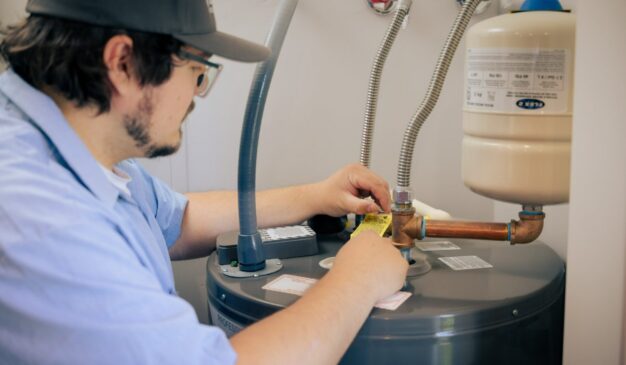
Water heater annual maintenance includes flushing sediment from a tank (or descaling a tankless unit), testing the temperature and pressure relief valve, checking the expansion tank and supply lines, confirming the temperature setting, and inspecting for leaks or corrosion. Most visits take about an hour, and you get clear answers on what we find.
This follows the same Precision Tune-Up approach we use on heating and cooling systems: Maintain, Prevent, Extend. Here is what that looks like for each type of water heater.
Tank water heaters (gas)
- Shut down the burner and connect a hose to the drain valve
- Flush sediment, minerals, and debris out of the bottom of the tank
- Test the temperature and pressure (T&P) relief valve
- Check the thermal expansion tank and the cold and hot supply lines
- Look for rust on fittings, leaks at the drain valve, and missing earthquake straps
- Refill, relight, and reset the water to its original temperature
Annual tankless water heater maintenance
A tankless unit does not collect sediment the same way. Instead, minerals build up as scale inside the heat exchanger. On our recent tankless visits, the technician runs a descaling solution through the unit for about 45 minutes, then flushes it with clean water for another 15. We also clean the inlet filter and test for proper operation. This requires service valves on the unit, so we check for those first.
Electric water heater maintenance checklist
- Turn off power at the breaker before any work begins
- Flush the tank to clear sediment that can coat the lower heating element
- Test the T&P relief valve
- Check the heating elements and thermostats for proper operation
- Confirm the temperature setting and inspect the expansion tank and supply lines
- For heat pump water heaters, clean the air inlet filter on top of the unit
Our technicians are NATE-certified and background-checked, and we arrive within a 2-hour window. You’ll see what we’re seeing and know what it means.
What we commonly find, and what it means for your water heater
Based on our service records, we completed 32 water heater maintenance and flushing visits across the South Sound since June 2026, in cities including Puyallup, Tacoma, Lakewood, Gig Harbor, and Kent. On 16 of those visits, the flush or descale was the main work. The rest turned into a closer look at something else.
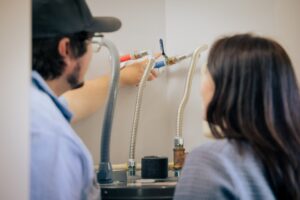
Knowing where your shutoff valve is can save you from major water damage.
Items handled as part of the service (included)
- Flushing sediment from the tank, or descaling a tankless unit
- Cleaning the tankless inlet filter or heat pump air filter
- Testing the T&P relief valve and checking the temperature setting
- Reading your home’s water pressure and checking for visible leaks
- A written summary of the condition of your water heater
Items that become a separate repair conversation (costs extra)
- Failed or missing expansion tank. This came up on 6 of our 32 visits. The expansion tank absorbs pressure as water heats. When it fails, that pressure goes back into the water heater and your plumbing.
- Worn supply lines or fittings. We replaced or recommended new supply lines on 5 visits, including rusting galvanized fittings.
- Leaking drain valve. Older plastic drain valves can crack or seep. We quote a full port brass ball valve instead.
- A tank too old to flush safely. On several visits the tank was 15 to 20+ years old. In those cases, we explain why a flush may do more harm than good and walk you through your options.
We always explain what a repair includes and give you upfront pricing before any work begins. If you only want the maintenance, that is all we do.
Example From a Recent Service Visit
A homeowner in Kent called because they were not getting as much hot water as they used to. They were not sure if something was wrong or if the tank just needed a flush. Our technician found sediment in the gas tank and a thermal expansion tank that had stopped doing its job.
Solution:
We flushed the tank to clear the sediment and installed a new expansion tank, charged to 60 PSI to match the home’s water pressure. After a flush, a tank like this one typically takes about an hour to fully reheat.
Is water heater annual maintenance worth it? 5 functional benefits
Yes, for most homes. A yearly flush or descale costs about $179 to $299 in our service records, and it keeps the water heater heating efficiently, catches leaks early, and keeps safety parts working. Skipping it for years can leave a tank too far gone to flush at all.
Here is what that maintenance does for you in practical terms.
1. Steadier hot water when you need it
Sediment settles at the bottom of a tank and takes up space that should hold hot water. It also sits between the burner and the water. Clearing it helps restore the hot water supply you are used to, as the Kent homeowner above found out.
2. Lower energy use
A layer of sediment or scale acts like insulation. The burner or element has to run longer to heat the same amount of water. A clean tank or heat exchanger transfers heat more easily, which means less wasted energy month after month.
3. Small leaks caught before they become big ones
Expansion tanks, supply lines, drain valves, and fittings wear out quietly. On our visits, we found failing expansion tanks, rusting galvanized nipples, a cracked drain valve, and a leaking condensate trap inside a tankless unit that had never been serviced. Each one was easier to fix on a scheduled visit than after water reached the floor.
4. Safer operation and code-ready equipment
The T&P relief valve is the safety device that releases pressure if something goes wrong. We test it every visit. We also check water temperature, water pressure, expansion tanks, and earthquake straps. On one Federal Way visit, a home inspection flagged water that was too hot, and we found the tank was missing both its expansion tank and its straps. We sent clear options to bring the water heater up to code before the sale.
5. A longer life for your water heater
Water heaters that get regular care stay serviceable. Ones that go years without it can reach a point where flushing is no longer safe. On two recent visits in Auburn and Kent, our technician could not complete a flush on aging tanks. On a Maple Valley tankless unit that had never been descaled, we recommended against starting now. Annual maintenance keeps you out of that situation.
Our work is backed by our quality assurance guarantees, including a 100% Money-Back Guarantee on repairs and installations. Pacific has served Western Washington since 1984 and has earned more than 6,000 Google reviews with a 4.9 average.
| Service | Typical price in our service records |
|---|---|
| Tank water heater flush | $179 to $199 |
| Tankless water heater descale | $269 to $299 |
| Dispatch charge | $77, or $29 for Club members, often credited toward the service |
Members of our Peace of Mind Club get the reduced dispatch fee, priority scheduling, and 24/7 emergency support. If a repair or replacement comes up, we also offer financing options so you can choose what fits your budget.
How often should a water heater be serviced?
Most water heaters should be serviced once a year. That includes gas, electric, heat pump, and tankless models. Our technicians note on every invoice that flushing and descaling are annual maintenance tasks, which matches what manufacturers specify. Homes with harder water or heavy hot water use may benefit from more frequent checks.
In Western Washington, early fall is a smart time to schedule. Hot water demand climbs as the weather cools and the house fills up for the holidays. Many homeowners pair it with their furnace or heat pump tune-up so both are ready for winter.
If your water heater is more than 10 years old and has never been serviced, start with an inspection rather than a flush. We will check its condition first and tell you honestly whether maintenance still makes sense. We serve Tacoma, Puyallup, Lakewood, Gig Harbor, Kent, and the surrounding South Sound communities.
Ready to get your water heater on a yearly schedule? Book a visit through our water heater services page or call (253) 248-6260, and we will handle it for you. No Surprises. Just Solutions.
Frequently Asked Questions
-
-
A tank water heater needs a flush to clear sediment, a test of the temperature and pressure relief valve, and a check of the expansion tank, supply lines, and temperature setting. A tankless water heater needs a descale to remove mineral scale and a cleaning of its inlet filter. Both should be inspected for leaks and corrosion once a year.
-
-
In our service records, a tank water heater flush typically runs $179 to $199, and a tankless descale typically runs $269 to $299. There is a $77 dispatch charge, or $29 for Peace of Mind Club members, and it is often credited toward the service. You get upfront pricing before any work begins.
-
-
-
-
Many homeowners can drain a few gallons from a newer tank on their own, and that does help. The risk is with older tanks, where a plastic drain valve can crack or a corroded fitting can start leaking once disturbed. A technician also tests the relief valve, expansion tank, and water pressure, which a simple drain does not cover.
-
-
Start with an inspection, not a flush. On tanks that have gone years without service, heavy sediment can clog the drain valve or expose a weak spot once it is stirred up. A technician can check the condition first and tell you honestly whether maintenance or replacement makes more sense.
-
-
Yes. Minerals build up as scale inside the heat exchanger, which reduces efficiency and can trigger error codes over time. Manufacturers call for a yearly descale, and units that go many years without one may not be safe to start descaling. The service also requires isolation valves, which we check for first.
-
-
Most visits take about an hour. A tankless descale runs about 45 minutes plus 15 minutes of flushing with clean water. After a tank flush, plan on about an hour for the tank to fully reheat.
Still not sure if your system is ready for the season?
Tell us what your system is doing and we’ll help you figure out the right next step. Pacific Heating & Cooling has been diagnosing heating and cooling problems across Tacoma and the South Sound since 1984. NATE-certified technicians, 2-hour arrival windows, and upfront pricing before any work begins.