If your AC hums but never kicks on, or the outdoor unit sounds like it wants to start but just won’t, a failed capacitor is one of the most common reasons. The capacitor is the part that gives your compressor and fan motor the electrical boost they need to start running, and when it fails, the whole system stalls. In our service records, capacitor replacement is the single most common AC repair we complete across Western Washington, and most jobs are finished the same day. This post covers why capacitors fail, how to recognize the symptoms, and what replacement costs in Tacoma and the South Sound.
The most common causes of AC capacitor failure
Capacitors fail for a handful of predictable reasons. Knowing which one applies to your system helps you understand whether this is a one-time fix or a recurring issue worth addressing at the root.
Heat stress and overworking during hot weather
Capacitors are sensitive to heat, and the harder your system runs, the faster they wear out. This is the primary cause of summer failures. Based on our service records, we completed 855 capacitor replacements during the summer months of June, July, and August
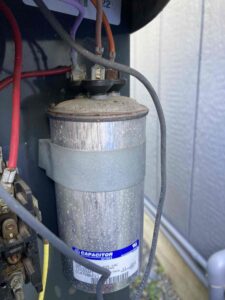
A dual run capacitor inside an outdoor AC unit. The weathering and oxidation on the casing are typical of a capacitor that has been through multiple Western Washington summers.
alone. That is nearly half of all capacitor jobs in our dataset, concentrated in just three months. Western Washington summers are shorter than other parts of the country, but when temperatures spike during a heat wave, systems run almost continuously, and that continuous strain pushes aging capacitors past their limit.
The fix: a technician removes the failed part, tests the new capacitor to confirm correct ratings, and installs the replacement. The system is tested before the technician leaves.
Example From a Recent Service Visit
A homeowner in Puyallup called because the outdoor unit was humming but the fan was not spinning, and the house was warming up fast on a 90-degree afternoon. The technician found a failed dual run capacitor with a visibly bulged top. The capacitor had weakened over several summers and finally gave out under the load of a heat wave.
Solution: We replaced the dual run capacitor, tested both the compressor and fan motor at startup, and confirmed normal operation before leaving. The system was back up within about an hour.
Age and normal wear
Capacitors are consumable parts. Most are rated for a service life of 10 to 20 years under normal conditions, but actual lifespan varies based on how hard the system runs, how well the system is maintained, and local conditions. In Western Washington, older homes running aging equipment through back-to-back summers will see capacitor failures even without a dramatic heat event.
The fix is the same as heat-related failure: replace the capacitor with a correctly rated part. If the system is over 10 to 15 years old and this is the second or third capacitor replacement, that is a useful data point for a broader conversation about system condition.
Power surges and electrical irregularities
A power surge, brownout, or unstable voltage can shorten a capacitor’s life significantly. The capacitor is one of the first components in the electrical path of the outdoor unit, which makes it vulnerable when power quality is poor. If you notice the failure happened shortly after a storm or utility event in your area, this may be the contributing factor.
A surge protector designed for HVAC equipment can reduce this risk going forward. Your technician can advise whether your system is currently protected.
Incorrect part ratings or installation
A capacitor installed with the wrong microfarad (MFD) or voltage rating will fail prematurely. This sometimes happens after a previous repair was done with a non-matching part. The most common dual run capacitors we replace in our service records are 45/5 MFD and 40/5 MFD configurations. Using a part outside the correct specification stresses the motor it is meant to support.
Our technicians carry a wide range of replacement capacitors and confirm the correct part before installation. NATE certification means the diagnostic is accurate and the replacement part is spec-matched to your system.
Refrigerant issues putting extra load on the compressor
When a system is low on refrigerant, the compressor works harder to maintain cooling. That extra load draws more current through the capacitor during startup, which accelerates wear. If your capacitor is failing repeatedly, a low refrigerant condition may be a contributing factor worth checking during the same visit.
Learn more about what happens when refrigerant runs low in our post on AC refrigerant leak signs and repair costs.
What a homeowner can do vs. what requires a technician
There are a few things you can safely check before calling. There are others that need a trained technician, and the capacitor itself falls firmly in that category.
What you can safely check at home
- Confirm the thermostat is set to Cool and the temperature is set below the current room temperature.
- Check the circuit breaker for the air conditioner. Reset it once if it has tripped. If it trips again, stop and call for service.
- Check that the disconnect box near the outdoor unit is fully closed and seated. Sometimes this gets disturbed during yard work or inspections.
- Look at the outdoor unit from a safe distance. If the fan is not spinning but you can hear the unit running or humming, that is a useful detail to share when you call.
What requires a technician
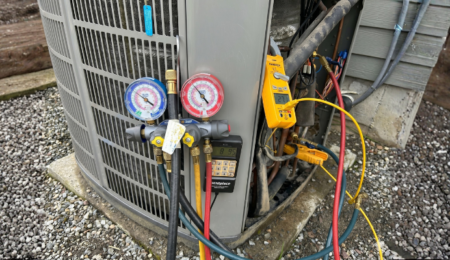
Testing and replacing a capacitor requires discharging the part safely before handling it. A capacitor can hold a dangerous electrical charge even when the system is off. This is not a DIY repair. A technician uses a multimeter to test the capacitor’s current reading against its rated value. A reading that has drifted outside acceptable range confirms failure even when the part looks physically intact. Our technicians also test the compressor and fan motor to confirm no secondary damage occurred from running with a failed capacitor.
Signs you should call for AC capacitor service
- The outdoor unit hums but the fan is not spinning
- The AC clicks on but nothing happens and the house keeps warming up
- The system starts and then immediately shuts off within a few seconds
- The system takes several tries before it will start and run
- You hear a clicking noise from the outdoor unit at startup with no follow-through
- The system worked fine yesterday and today will not start at all
Any of these symptoms during a stretch of hot weather points strongly toward a capacitor. The full list of reasons an AC stops cooling covers the broader diagnostic picture if you want to understand where capacitor failure fits among other common causes.
What does AC capacitor replacement cost in Tacoma and Western Washington?
Based on 1,927 capacitor replacement jobs in our service records, costs range from $26 to $488, with a median of $197 and a mean of $204. Most capacitor replacements fall between $150 and $250 when the part is a standard dual run configuration. Most repairs are completed the same day.
What drives the cost spread
- Capacitor type: Dual run capacitors serve both the compressor and fan motor and cost more than single-purpose run capacitors. The most common types we replace are 45/5 MFD and 40/5 MFD dual configurations.
- System accessibility: Outdoor units in tight mechanical areas or with non-standard configurations take more labor time.
- Secondary findings: If testing reveals the compressor or fan motor was damaged by running with a failed capacitor, that becomes a separate repair conversation with its own cost.
- Diagnostic fee: The diagnostic visit is what identifies the capacitor as the confirmed cause. Upfront pricing before any work begins is standard on every visit.
All pricing is confirmed before any work starts. No surprises.
We see this repair most often in Tacoma (503 jobs), Puyallup (163), Gig Harbor (109), Olympia (104), and Lakewood (102). If you are in any of these communities or the surrounding South Sound, a same-day appointment is typically available during non-peak periods. During July and August, scheduling ahead by even a day or two helps.
FAQ: Common AC Capacitor Questions
-
-
Based on 1,927 capacitor replacement jobs in our service records, costs range from $26 to $488, with a median of $197. Most standard dual run capacitor replacements fall between $150 and $250. The final cost depends on the capacitor type, system access, and whether any secondary components were affected. Pricing is confirmed before any work begins.
-
-
This is not a safe DIY repair. A capacitor stores an electrical charge and can deliver a serious shock even after the system is powered off. A technician safely discharges the part before testing or replacing it and confirms the correct MFD and voltage ratings for your specific system. Using a mismatched part causes premature failure.
-
-
Most capacitors are rated for 10 to 20 years under normal operating conditions, but real-world lifespan depends on heat exposure, how hard the system runs, and whether the part was correctly sized at installation. Capacitors in systems that run hard during heat waves often fail sooner. Annual tune-ups include a capacitor inspection so declining parts can be caught before failure.
-
-
Repeated capacitor failures usually point to an underlying issue, not just bad luck. Common contributing factors include low refrigerant putting extra load on the compressor, a system running at the edge of its capacity, a previous replacement with a mismatched part, or a compressor or motor that is drawing more current than it should. A technician can test for these during the same visit.
-
-
Usually not, or not reliably. A failed start capacitor means the compressor and fan motor do not get the electrical boost they need to start. You may hear the unit humming or clicking, but it will not run a full cooling cycle. Running the system when it is struggling to start can cause further damage to the compressor or fan motor, which are much more expensive to replace.
-
-
In most cases, yes. A capacitor replacement is one of the least expensive AC repairs, and if the rest of the system is in reasonable condition, it is almost always worth doing. If the system is over 15 years old and has had multiple repairs in recent seasons, your technician can walk you through a repair vs. replace conversation so you can make a confident decision.
-
-
A capacitor replacement typically takes 60 to 90 minutes from the time the technician arrives, including the diagnostic to confirm the cause and a full system test after the replacement. Most repairs are completed the same day. During July and August when demand peaks, scheduling a day or two ahead is helpful.
Still not sure what’s causing the problem?
Tell us what your system is doing and we’ll help you figure out the right next step. Pacific Heating & Cooling has been diagnosing heating and cooling problems across Tacoma and the South Sound since 1984. NATE-certified technicians, 2-hour arrival windows, and upfront pricing before any work begins.