By Pacific Heating & Cooling | NATE-Certified Service Technicians | Updated August 2026
If your heat pump is not heating or cooling the way it should, blowing air that is not warm or cold enough, freezing over outside, or making a noise it never used to make, something in the system needs attention. The six most common causes are a thermostat or control issue, low refrigerant, ice buildup from a defrost cycle problem, an electrical failure in the capacitor or contactor, a failing reversing valve, or worn components creating noise, and a licensed technician can diagnose most of these in a single visit. Here is what each cause looks like, what a homeowner can safely check first, and what heat pump repair typically costs across Tacoma and the South Sound.
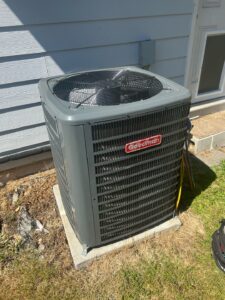
A Goodman heat pump outdoor unit, one of the systems Pacific services across Tacoma and the South Sound.
The 6 most common heat pump problems in Tacoma homes
Pacific Heating & Cooling has handled more than 4,600 heat pump service calls across Western Washington over the past two years, most often in Tacoma, Gig Harbor, Lakewood, Puyallup, and Olympia. Six causes show up again and again. Here they are, in the order our NATE-certified technicians see them most.
1. Thermostat or control settings
This is a mix of simple setup issues and thermostat hardware problems. A system set to the wrong mode, a dead thermostat battery, or a miscommunicating smart thermostat can all look like a much bigger problem than they are.
You will usually notice the system simply will not turn on, the display is blank, or the temperature never seems to change no matter what you set it to.
Our technicians confirm the thermostat is communicating correctly with the system, check the wiring at the control board, and correct the settings or replace the thermostat if it has failed.
2. Low refrigerant or a refrigerant leak
A heat pump moves heat using refrigerant, and it needs the correct amount to do that efficiently in both heating and cooling mode. A leak means the system is losing refrigerant faster than it should.
Homeowners usually notice the system running longer than normal, weaker heating or cooling output, or ice forming on the indoor or outdoor coil.
We use gauges to check the refrigerant charge, then perform a leak search to find the source before adding refrigerant. Topping off refrigerant without finding the leak just means the same problem comes back.
3. Ice buildup from a defrost cycle problem
Heat pumps normally build a light layer of frost in cold, damp weather, which is common in Western Washington winters, and then melt it off automatically through a defrost cycle. When that cycle fails, ice keeps building instead of clearing.
The sign is hard to miss: heavy ice covering most or all of the outdoor unit, sometimes with reduced heating as the ice restricts airflow across the coil.
A technician checks the defrost control board, the coil temperature sensor, and the outdoor ambient sensor, since a fault in any one of these can stop the defrost cycle from triggering correctly.
Example From a Recent Service Visit
A homeowner in Tacoma had us back out for a follow-up visit because their heat pump was still struggling to complete its defrost cycle in cold weather. During the visit, our technician traced the problem to the defrost control board, the coil temperature sensor, and the outdoor ambient sensor, all of which were affecting how the system read outdoor conditions.
Solution: We replaced all three components under the manufacturer’s parts warranty and confirmed a full defrost cycle before we left, so the homeowner could count on steady heat for the rest of the season.
4. Electrical failures: capacitor, contactor, tripped breaker, or blown fuse
The capacitor gives the compressor and fan motor the jolt of power they need to start. The contactor controls power to the outdoor unit. Either one can fail, and a tripped breaker can point to a problem with either part.
Watch for a humming outdoor unit where the fan is not spinning, a system that clicks but does not start, or one that trips the breaker repeatedly.
We test both components with a meter, confirm which one has failed, and replace it. Most electrical repairs like this are completed the same visit.
A tripped breaker doesn’t always point to the capacitor or contactor, though. A few other causes are worth ruling out:
- A blown low-voltage fuse. If the thermostat is blank or the system won’t power on, the fuse on the indoor control board (typically 3 or 5 amps, depending on the system) may have blown. A fuse that keeps blowing after replacement means something else is causing a short — a damaged wire touching bare metal, a miswired thermostat, or damaged wiring to the outdoor unit — not a fuse problem itself.
- A loose connection at the breaker, disconnect, or equipment lugs. This can cause intermittent trips that don’t show up on a visual check alone. We confirm proper voltage under load, not just at idle, to catch this.
- A failing compressor. If the breaker trips specifically when the system tries to start, rather than while it’s running, the compressor itself may be drawing excessive current or beginning to fail electrically.
5. A failing reversing valve
The reversing valve is what lets a heat pump switch between heating and cooling. When it sticks or fails, the system can get stuck in one mode or blow the wrong temperature of air entirely.
The clearest sign is a system that blows cool air when it is set to heat, or warm air when it is set to cool, for more than a few minutes.
Our technicians test the valve directly and replace it if it is not switching correctly. This is a more involved repair, but it restores full heating and cooling function.
Not every case of the wrong-temperature air points to the reversing valve, though. A few things worth ruling out first:
- A thermostat wiring mistake, often introduced during a recent thermostat swap.
- A control or staging configuration issue, where the system isn’t set up to communicate correctly between components.
- Refrigerant issues, which can also produce this symptom.
6. Worn components causing unusual noise
Buzzing, rattling, grinding, or a new humming sound almost always means a mechanical or electrical part is wearing out, loose, or already failing.
Pay attention to when the noise happens: at startup, while running, or when the system shuts off, since that timing helps narrow down the cause before a technician even arrives.
We inspect the fan motor, blower assembly, and mounting hardware, then repair or replace whatever is creating the noise before it causes further damage.
What a homeowner can do vs. what requires a technician
Quick answer: homeowners can safely check the thermostat, the air filter, and the area around the outdoor unit. Diagnosing refrigerant levels, electrical components, and the reversing valve requires a licensed technician with the right tools.
Four quick checks first:
- Thermostat: Confirm it is set to Heat or Cool, not Off, and set the temperature a few degrees past the current indoor reading to trigger a call for heat or cool.
- Air filter: Pull it and look at it. Replace it if it looks dirty. A clogged filter restricts airflow and can contribute to ice buildup.
- Outdoor unit: Clear leaves, debris, or anything blocking airflow. Some frost in winter is normal, but a fully iced over unit should be inspected.
- Outdoor fan: Listen for it when the system is calling for heat or cool, and make a note if it is not running so you can describe it when you call.
What requires a technician:
Checking refrigerant charge, testing electrical components like the capacitor and contactor, diagnosing the reversing valve, and reading fault codes from the control board all require training and equipment a homeowner would not typically have on hand. Every Pacific technician is NATE-certified and background-checked, and they follow a systematic process on every visit so nothing gets missed, walking you through what they find in plain language before any repair begins.
Signs you should call for heat pump repair
Call for heat pump repair if you notice any of these:
- The outdoor fan is not spinning even though the unit is humming or the system is calling for heat or cool.
- Ice covers most or all of the outdoor unit and does not clear on its own within a few hours.
- The system blows the wrong temperature air, cool air in heat mode or warm air in cool mode, for more than a few minutes.
- The system short cycles, turning on and off every few minutes instead of running a full cycle.
- You hear grinding, buzzing, or a new rattling noise from the outdoor unit that was not there before.
- A fault code or flashing light appears on the thermostat or the outdoor unit’s control board.
- You smell burning or notice heat damage near the electrical panel, disconnect, or the unit itself.
- You hear buzzing specifically at the electrical panel or disconnect box, separate from any noise coming from the unit itself
Resetting a tripped breaker once is reasonable. If it trips again, stop and schedule service — repeated resets can damage equipment and create a safety risk.
Pacific Heating & Cooling offers 2-hour arrival windows and NATE-certified technicians, so you are not left guessing when help is on the way.
What does heat pump repair cost in Tacoma and Western Washington?
Based on a review of recent heat pump service invoices, a diagnostic-only visit typically runs $70 to $150. Completed repairs range from about $160 up to just over $6,000, with most falling in the low to mid hundreds depending on the part involved and whether refrigerant is needed.
The low end of that range covers simpler fixes like a capacitor, contactor, or thermostat replacement. The high end reflects major component failures, such as a compressor or extensive refrigerant work, which are far less common than the everyday repairs most homeowners call about. Part cost, how much refrigerant is needed, and labor complexity all factor into where a specific repair lands in that range.
We provide upfront, itemized pricing before any work begins, so you know the cost of the repair before you agree to it. Most repairs are completed the same day.
“Josh really knows his stuff! He managed to troubleshoot and repair our heat pump in one visit. He had the parts on the truck. Josh is also very personable and represents Pacific Heating very well.”
Ed in Yelm
If a repair starts to approach what a new system would cost, especially on an older heat pump, it is worth asking about your options. Pacific offers free replacement consultations alongside every repair estimate so you can compare costs before deciding, and our financing options can help spread the cost of a larger repair or replacement if needed.
Homeowners who want to catch these problems before they turn into a breakdown can also ask about Pacific’s Peace of Mind Club membership, which includes annual tune-ups, priority scheduling, and reduced diagnostic fees. Every repair and installation is also backed by our 100% money-back guarantee, so you are covered if something is not right.
If you are weighing a repair against a full system change, our guide on choosing between a dual fuel and all-electric heat pump setup walks through what to consider before your next install.
FAQ: Common Questions About Heat Pump Malfunctions
-
-
A minor issue usually looks like a thermostat setting, a dirty filter, or light frost that clears within a few hours. A serious issue usually looks like heavy ice that does not clear, the wrong temperature of air blowing for more than a few minutes, grinding or buzzing noises, or a fault code on the control board. If you are not sure which one you are looking at, a diagnostic visit will tell you for certain before any repair work starts.
-
-
Based on recent service invoices, a diagnostic-only visit typically costs $70 to $150. Completed repairs range from about $160 to just over $6,000, with most landing in the low to mid hundreds depending on the part involved. We provide upfront, itemized pricing before any work begins, so you know the cost before you agree to it.
-
-
Most heat pump repairs, including capacitor, contactor, and thermostat issues, are completed in a single same-day visit once the part is identified. More involved repairs, like a reversing valve replacement or a part that needs to be ordered, may take a return visit. Your technician will tell you which situation you’re in before starting the repair.
-
-
A brief moment of cooler air right when the system switches on is normal, since it takes a minute for the coil to warm up. It is not normal if that cooler air continues for several minutes or longer. That usually points to a refrigerant issue or a failing reversing valve, both of which need a technician to diagnose.
-
-
We would not recommend it. Refrigerant handling requires EPA certification and the right equipment, and adding refrigerant without finding the leak first just means the same problem comes back, often after you have already spent money on it. A technician finds the leak, repairs it, and then charges the system to the correct level so the fix actually holds.
-
-
A light layer of frost in cold, damp weather is normal and clears on its own through the system’s automatic defrost cycle. Heavy ice that does not clear usually means the defrost cycle is not triggering correctly, often because of a problem with the defrost control board or one of its sensors. That is worth a diagnostic visit rather than waiting for it to melt on its own.
-
-
It depends on the age of the system and the cost of the repair. As a general rule, if a repair costs more than half of what a new system would cost and your heat pump is more than 10 to 15 years old, replacement is usually the better long-term value. Pacific offers a free replacement consultation alongside every repair estimate, so you can compare both options with real numbers before deciding.
Still not sure what’s causing the problem?
Tell us what your system is doing and we’ll help you figure out the right next step. Pacific Heating & Cooling has been diagnosing heating and cooling problems across Tacoma and the South Sound since 1984. NATE-certified technicians, 2-hour arrival windows, and upfront pricing before any work begins.