By Pacific Heating & Cooling | NATE-Certified Service Technicians | Updated August 2026
Your water heater is failing, or it is old enough that waiting for it to fail feels risky, and now you are trying to decide whether to replace it with the same kind of tank system or switch to tankless. A tank water heater stores and continuously reheats 40 to 50 gallons of hot water in an insulated tank, while a tankless water heater has no storage at all and heats water on demand as you use it. Here is how the two compare on upfront cost, energy use, lifespan, and what actually makes sense for a home in Tacoma or the surrounding South Sound, based on our own water heater installation records.
Quick comparison: tankless vs. tank water heater
Before getting into the details, here is how the two options stack up side by side. Your home’s setup, current gas or electrical service, and household size will decide which column fits you best.
| Tank Water Heater | Factor | Tankless Water Heater |
|---|---|---|
| $3,700 to $4,400 typical, based on 205 installs in our service records | Upfront installation cost | Higher, often $5,000 to $8,000 or more once gas line or electrical upgrades are needed |
| Takes up floor space in a garage, closet, or basement | Space needed | Wall-mounted, frees up floor space |
| Limited to tank size, 40 to 50 gallons for most homes | Continuous hot water | Unlimited, as long as flow rate demand is within the unit’s capacity |
| Reheats water continuously, even when nobody is home | Energy efficiency | Heats only on demand, generally lower standby energy loss |
| 8 to 12 years typical | Expected lifespan | 15 to 20 years with proper maintenance |
| Annual flush recommended | Maintenance | Annual descaling recommended, especially with hard water |
| Straightforward replacements, smaller households, lower upfront budget | Best for | Larger households, long-term homeowners, homes with strong existing gas or electrical service |
Tank water heaters: what they do well and where they fall short
A tank water heater keeps a set amount of hot water ready at all times and costs less to install, but it runs out of hot water once the tank empties and takes up floor space. This is still the most common choice we see across Tacoma, Puyallup, and the rest of our South Sound service area.
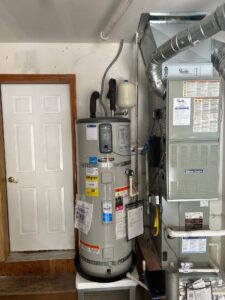
Bradford White heat pump water heater and American Standard furnace installation — Pacific Heating and Cooling, Tacoma WA
The main advantage is simplicity. A tank system works with your home’s existing gas line or electrical circuit in most cases, so the install itself is usually a same-day job. Pacific Heating & Cooling has been installing and servicing these systems across Western Washington since 1984, and a straightforward tank replacement remains one of the most predictable jobs we do.
The tradeoff is capacity and lifespan. Once the 40 to 50 gallon tank runs out during back-to-back showers or a full load of laundry, everyone waits for it to reheat. Tank systems also have a shorter service life than tankless units, typically 8 to 12 years, and they reheat water around the clock even when your home is empty, which adds up in standby energy cost over time.
Older homes throughout Pierce and Thurston County sometimes have tanks well past that 12 year mark still running, but an aging tank is more likely to leak without warning. If yours is approaching or past that age, it is worth a look before it fails on its own schedule instead of yours.
Tankless water heaters: what they do well and where they fall short
A tankless water heater delivers hot water on demand with no storage tank, which means it will not run out, but it costs more upfront and may need gas line or electrical upgrades depending on your home. In our own installation records from June 2025 to April 2026, we completed 205 tank water heater installations and just one tankless installation in that same window.
That gap is not because tankless technology is unreliable. It comes down to what a tankless conversion actually requires. A tankless unit needs a much higher flow rate than a standard tank, which often means a larger gas line, a dedicated vent, or an upgraded electrical circuit for electric models. Several homeowners in our records asked about switching to tankless during a sales consultation, and more than one ultimately chose a tank system instead once they saw what the gas line or electrical upgrade would add to the project.
Where tankless makes sense is longevity and continuous supply. A well-maintained tankless unit can last 15 to 20 years, well beyond a typical tank, and it never runs cold mid-shower regardless of how many fixtures are running. For a larger household, or a homeowner planning to stay in the home long enough to recover the higher install cost through energy savings, that tradeoff can be worth it.
Hard water in parts of our service area can also affect tankless units more than tank systems, since mineral buildup inside the narrow heat exchanger reduces efficiency faster than it does inside a tank. Annual descaling keeps this in check, and it is worth budgeting for as part of ongoing maintenance, not just the install itself.
How to decide: tankless vs. tank water heater for your home
A few honest questions will point you toward the right answer faster than a sales pitch will. We walk every homeowner through these same questions during a water heater assessment, no pressure either direction.
- How many people, and how many bathrooms, does the system need to support? A larger household running multiple showers back to back is where tankless shows its biggest advantage.
- Does your home already have the gas line size or electrical capacity a tankless unit needs? If yes, the cost gap narrows considerably. If not, that upgrade is a real cost to factor in up front.
- How long do you plan to stay in the home? Tankless systems pay back their higher cost over time through efficiency and lifespan, so the math favors homeowners staying put for years, not months.
- What is your budget for this specific repair or replacement right now? A tank replacement is almost always the lower upfront cost, which matters when a water heater fails without warning.
- Is this an emergency replacement or a planned upgrade? Emergency replacements often favor tank systems simply because parts and install timing are more predictable.
None of these questions have a universally right answer. They are the same ones our technicians ask during a diagnostic visit, and we will walk you through your options once we know your home’s setup.
What Pacific installs and why
Based on our service records, Pacific completed 205 tank water heater installations between June 2025 and April 2026, compared with a single tankless installation in that same period. Gas tank systems made up roughly three out of every four of those jobs, with electric tank systems making up the rest.
The top cities for these installs were Tacoma, Puyallup, Lakewood, Gig Harbor, and Auburn, which lines up with where most of our service calls come from across the South Sound. Most tank replacements were completed the same day, and every install includes a walkthrough so you understand your new system before we leave.
Felix in Graham put it this way:
“Got a new water heater installed, process was easy and within a timeframe that worked perfectly, I feel the price was a little steep but I did go with a higher end brand and it may be the only water heater I ever have to buy for this house soooo… It’s all good.”
Felix in Graham
Every water heater installation and repair we complete is backed by our 100% Money-Back Guarantee, and we handle the permit and inspection process for you either way. Homeowners taking on a larger install, especially a tankless conversion with gas or electrical upgrades, can also look into our water heater financing options to spread out the cost. Club members get priority scheduling on installs through our Peace of Mind Club membership, and you can read more from homeowners across our customer testimonials page.
Still not sure which system is right for your home?
Tell us what your system is doing and we’ll help you figure out the right next step. Pacific Heating & Cooling has been diagnosing heating and cooling problems across Tacoma and the South Sound since 1984. NATE-certified technicians, 2-hour arrival windows, and upfront pricing before any work begins.
FAQ: Common Questions about Water Heater Tanks
-
-
Based on 205 tank water heater installations we completed between June 2025 and April 2026, most jobs run from $3,700 to $4,400, with a median around $4,030. Tankless installations cost more up front, especially when gas line or electrical upgrades are needed to support the higher output.
-
-
It depends on how much hot water your household uses and how long you plan to stay in the home. Tankless systems can last longer and lower your energy bills, but the higher installation cost takes years to pay back through savings alone, so it makes the most sense for larger households or long-term homeowners.
-
-
We would not recommend it. Gas tankless units need a properly sized gas line, dedicated venting, and often an upgraded electrical connection, and getting any of that wrong creates a safety risk and can void the manufacturer’s warranty. A permit and inspection are also required in Washington for water heater replacements.
-
-
Most tank water heater replacements are completed in one visit, generally within a few hours. Tankless installations can take longer, especially the first time a home is converted, since the technician may need to run new gas lines, install new venting, or upgrade the electrical panel.
-
-
A standard tank water heater typically lasts 8 to 12 years. A well-maintained tankless system can last 15 to 20 years, which is one of the main reasons homeowners consider the switch despite the higher upfront cost.
-
-
Yes. Water heater replacements in Washington require a permit and inspection, and this applies to both tank and tankless systems. We handle the permit and inspection process as part of every installation, so you do not have to manage it yourself.
-
-
Tank sizing is based on the number of bathrooms and people in the home, with 40 to 50 gallons covering most households in our service area. Tankless sizing is based on peak flow rate, meaning how many fixtures might run hot water at the same time, which we calculate during your in-home assessment.
Still not sure which system is right for your home?
Tell us what your system is doing and we’ll help you figure out the right next step. Pacific Heating & Cooling has been diagnosing heating and cooling problems across Tacoma and the South Sound since 1984. NATE-certified technicians, 2-hour arrival windows, and upfront pricing before any work begins.