Water is spreading across the floor, a pipe just gave way, or a fixture will not stop running, and you need it to stop right now. Your home’s main water shut off valve is almost always located where the main water line enters the house, most often in the garage, the crawl space, the basement, or near the water heater, with a second shut off at the street inside the water meter box. (This one requires a water meter key to access, these can be purchased at any local hardware store.) Below we walk you through exactly where to look, how to shut the water off safely, what to check before you ever need it, and when it makes sense to call a plumber here in the South Sound.
Where is the main water shut off valve in your home?
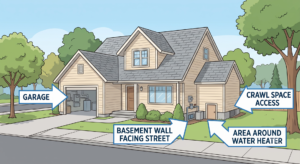
Common places to find your home’s main water shut-off valve. The exact spot varies by how and where your home was built.
In most Western Washington homes, the main water shut off valve sits where the water line first enters the house. Check the garage, the crawl space, a basement wall facing the street, or the area around your water heater. Many homes also have a second shut off at the street, inside the water meter box near the curb.
The valve itself looks like one of two things. Older homes often have a round handle you turn like a wheel. Newer homes usually have a straight lever you turn a quarter turn. If you follow the largest water pipe back from your water heater, it will often lead you to the main valve.
The valve at the street sits inside a covered box in the ground and usually needs a meter key to reach. That one belongs to the water utility, so the valve inside your home is the one to know and the one to use first.
Pacific Heating & Cooling has served homeowners across the South Sound since 1984, and one thing holds true in home after home: the people who stay calm during a leak are the ones who already know where this valve is.
One newer homes there is a possibility that it may be located on a wall in a closet or behind an access panel too.
The two shut off valves every homeowner should know
There are two kinds of shut off in your home, and knowing the difference saves you from turning off water to the whole house when you do not need to.
Your main whole-home shut off
This is the valve that stops water to the entire house. Use it for a burst pipe, a major leak, or any situation where you cannot tell where the water is coming from. When in doubt, this is the one to close.
Fixture shut offs at each appliance and fixture
Most sinks, toilets, and appliances have their own small shut off valve nearby. You will find them under sinks, behind toilets, at the washing machine, and at your water heater. If a single toilet is overflowing, you can close the small valve behind it and leave water running everywhere else in the house.
How do you shut off the water in an emergency?
To shut off your water in an emergency, find the main valve, then turn a round handle clockwise until it stops, or turn a lever valve a quarter turn so it sits across the pipe. Next, open the lowest faucet in the house to release the leftover pressure. Once you know where the valve is, this takes under a minute.
A few safety notes matter here. If a round handle valve feels stuck, do not force it with a wrench or a pipe. Older valves can crack or snap the pipe when pushed too hard, which turns a small leak into a bigger one. If it will not turn with reasonable hand pressure, stop and use the shut off at the street or call for help.
This is something a homeowner can and should be ready to do. Replacing a failed valve, tracing a hidden line, or fixing the leak behind it is where a plumber comes in.
Emergency shut off, step by step
- Find it: garage, crawl space, basement, or near the water heater.
- Close it: round handle turns clockwise, lever turns a quarter turn.
- Drain it: open the lowest faucet to release pressure.
- Do not force it: a stuck valve means stop and call, not push harder.
Knowing these four steps before a leak happens is the difference between a quick save and a soaked floor.
What to check now, before you ever need it
The worst time to learn about your shut off valve is during a flood. A few minutes of preparation now makes a real difference later. This is general guidance every homeowner can act on today.
First, find the valve and tag it so everyone in the household knows where it is. Second, gently test it by closing and reopening it, so you know it turns and are not surprised by a frozen handle in an emergency. Third, learn which valve type you have.
Older round-handle gate valves, common in many older South Sound homes, can seize up or start to drip the first time they are turned after years of sitting. Newer quarter turn ball valves are far more reliable and close fully with a single motion. If your valve drips after you close it, spins without stopping the water, or shows green corrosion, it is worth replacing before it fails when you need it most.
| Older gate valve | Factor | Quarter turn ball valve |
|---|---|---|
| Round wheel handle | How it looks | Straight lever handle |
| Several full turns | How to close | One quarter turn |
| Can seize or leak with age | Reliability | Closes fully and lasts |
If you would rather not test the valve yourself, or you find one that looks worn, our plumbing team can inspect it and, when needed, replace an old gate valve with a modern quarter turn valve. You get clear, upfront pricing before any work begins, and the work is backed by our No Worry, No Breakdown Guarantee.
When should you call a plumber?
Call a plumber if your main shut off valve is stuck, drips, or spins without stopping the water, if you cannot find a shut off anywhere in the home, or if you want to replace an older valve with a reliable quarter turn model before an emergency happens. A valve that fails during a leak turns a small problem into water damage.
Here are the clear signs it is time to call:
- The main valve will not turn by hand, or feels frozen in place.
- The valve still drips or the pipe still has pressure after you close it.
- The handle spins freely without shutting the water off.
- You see green corrosion, rust, or mineral buildup on the valve body.
- You cannot locate a main shut off valve inside your home at all.
- You want an old valve swapped for a dependable quarter turn valve.
Pacific Heating & Cooling is locally and family owned, and has been trusted across Tacoma, Puyallup, Lakewood, Gig Harbor, Olympia, and the wider South Sound since 1984. Our technicians are background checked, we offer 2-hour arrival windows, and we handle the work so you do not have to worry about it. You can also see what neighbors say about our work before you book. For ongoing peace of mind, our Peace of Mind Club adds priority scheduling and 24/7 emergency support. To learn more about our newest offering, see our new plumbing services. We serve homeowners in Tacoma, Puyallup
Knowing where your shut off valve is, and knowing it works, is one of the simplest ways to protect your home. If you would like us to inspect or replace yours, we make it easy and we walk you through your options. Call Pacific Heating & Cooling at (253) 248-6260 and we will help you figure out the right next step. No Surprises. Just Solutions.
FAQ: Common Shut off Valve Questions
-
-
Start by following the largest water pipe back from your water heater, since it often leads to the main valve. Also check the garage, crawl space, and basement walls that face the street. If you still cannot find one inside, use the shut off at the street inside the meter box, and consider having a plumber locate or install an accessible indoor valve.
-
-
For a short shut off you usually do not need to touch the water heater. If the water will be off for a long time or the tank could drain, turn the water heater to its vacation or pilot setting first, or switch off the breaker for an electric unit, so the heating element does not run without water. When in doubt, a plumber can walk you through it.
-
-
-
-
The cost depends on the valve type, where it sits, and how easy the pipe is to reach. Rather than guess, we give you clear, upfront pricing before any work begins, so there are no surprises. Every repair is also backed by our 100% money-back guarantee.
-
-
Some handy homeowners do, but it carries real risk. The main valve sits on a live pressurized line, older pipe can crack when disturbed, and a bad connection can leak behind a wall for weeks. If you are comfortable soldering or working with pipe fittings and can fully shut water off upstream, it is doable. If not, a plumber can do it quickly with a clean, tested connection.
-
-
Still not sure if your system is ready for the season?
Tell us what your system is doing and we’ll help you figure out the right next step. Pacific Heating & Cooling has been diagnosing heating and cooling problems across Tacoma and the South Sound since 1984. NATE-certified technicians, 2-hour arrival windows, and upfront pricing before any work begins.