By Pacific Heating & Cooling | NATE-Certified Service Technicians | Updated August 2026
If you are replacing a water heater in Western Washington, you may have been told you also need an expansion tank, and you are probably wondering whether that is a real requirement or an easy add-on. In Washington, you need a water heater expansion tank whenever your home has a closed plumbing system, meaning a check valve, backflow preventer, or pressure-reducing valve sits on the main water line, and the plumbing code Washington follows requires the tank any time a water heater is installed on that kind of system. Here is what an expansion tank does, when Washington code requires one, what it costs as part of a water heater installation, and how to tell whether your home already has what it needs.
What does a water heater expansion tank actually do?
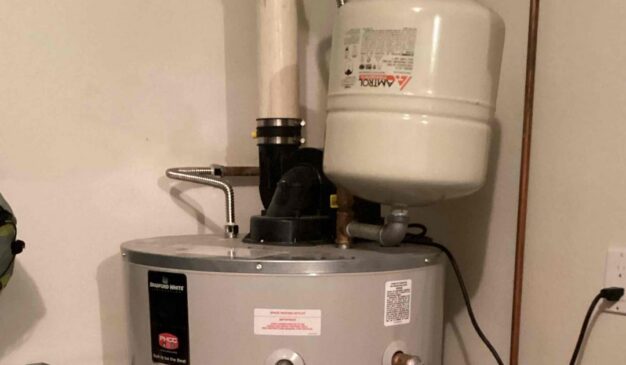
An expansion tank mounted above the water heater gives heated water room to expand and protects your plumbing on a closed system.
A water heater expansion tank is a small tank, usually mounted on the cold water line above the water heater, that gives heated water somewhere to go as it expands. Water expands when it heats up. In a closed system, that extra volume has nowhere to escape, so pressure climbs. The expansion tank absorbs that pressure and protects your pipes, fittings, and the water heater itself.
Think of it as a cushion. Without it, every heating cycle pushes pressure against valves, joints, and the tank. Over time that stress shows up as dripping relief valves, loud pipes, leaks at fittings, or a water heater that fails earlier than it should. With a properly sized tank in place, the pressure has a place to go and your system runs the way it was designed to.
At Pacific Heating & Cooling, we have installed and serviced water heaters across the South Sound since 1984, and this is one of the details that separates a code-compliant install from a shortcut. You can read more about our water heater work on our water heater service page.
Does Washington code require a water heater expansion tank?
Yes, in most cases. Washington follows the Uniform Plumbing Code, which requires thermal expansion control on any closed water system. If your home has a pressure-reducing valve, a check valve, or a backflow preventer on the main line, your system is closed, and an expansion tank is required whenever a water heater is installed or replaced. Local inspectors in Pierce, Thurston, and King counties enforce this at the permit inspection.
Most newer homes in Western Washington have a closed system, because pressure-reducing valves and backflow devices are now standard. Older homes may have been open when they were built, but a closed system is often created later without the homeowner realizing it, for example when the water utility adds a backflow device at the meter.
This is also why the requirement can feel like it came out of nowhere. Your last water heater may not have had an expansion tank, but if your system became closed since then, code now calls for one. We handle permits, inspections, and registration for you, so the install is done right and passes the first time. If you want to confirm the requirement for your exact address, your local city or county permitting office can verify it.
How to tell if your home has a closed system
- Check the main water line. Look for a bell-shaped valve near where water enters the home. That is usually a pressure-reducing valve, and it closes the system.
- Check near your water meter. A backflow preventer or check valve added by the utility also closes the system.
- Watch for pressure signs. A relief valve that drips, pipes that bang, or faucets that surge can all point to trapped thermal expansion.
Not sure what you are looking at? We can confirm it during a visit and walk you through what we find.
What we find during water heater work, and what it means
When we replace a water heater, an expansion tank is part of bringing the system up to current code. Some items are included in a standard code-compliant installation. Others turn into a separate conversation only if we find an existing problem. We keep these clearly separated so you always know what is included and what is not.
Included as part of a code-compliant water heater installation:
- A properly sized expansion tank when your system is closed and code requires one.
- Correct mounting and connection on the cold water line.
- Setting the tank pressure to match your home’s water pressure.
- Permit, inspection, and registration handled by us.
Handled as a separate repair conversation if we find it:
- High incoming water pressure that needs a new pressure-reducing valve.
- Corroded or undersized supply piping that should be replaced.
- An older expansion tank that has already failed and waterlogged.
We will always explain what we are seeing before any work begins, with upfront pricing and no surprises. You will see what we are seeing and know what it means, so the decision is yours.
Example From a Recent Service Visit
A homeowner in Olympia called about a 2009 water heater that was failing, and the incoming water line had actually blown out a section of copper piping. On a closed system with no working expansion tank, the repeated pressure spikes had stressed the pipe until it gave way.
Solution:
We installed a new water heater in Olympia along with a properly sized expansion tank, new valves, and corrected piping, so the system had a place to absorb pressure and would not fail the same way again.
Is a water heater expansion tank worth it, and what does it cost?
Yes. An expansion tank is worth it because it protects a much larger investment, your water heater and your plumbing, for a small added cost, and because it is required by code on a closed system, so passing inspection is not optional. On its own it is one of the smaller plumbing jobs we do. As part of a new water heater, it is a modest line item, not a major expense.
Based on our service records from June 2025 through April 2026, we completed 205 water heater installations across Western Washington. Total installed costs ranged from under $500 for a small job such as adding an expansion tank on its own, up to about $11,000 for a high-efficiency heat pump water heater that needed relocation or added electrical work. A typical water heater installation landed near $4,300.
| Water heater installation scenario | What drives the cost |
|---|---|
| Expansion tank added on its own | Smallest job. Tank plus labor to tee it into the cold line. |
| Standard water heater replacement | Tank type and size, fuel type, and any code upgrades needed. |
| Heat pump water heater or relocation | Higher end. Added electrical work, new location, or piping changes. |
We see water heater work most often in Tacoma, Lakewood, Puyallup, Gig Harbor, Auburn, and Federal Way. Wherever you are in our South Sound service area, you get the same upfront pricing before any work begins. For larger jobs, we also offer flexible financing options so the cost is easy to plan for.
Here is what Marjana in Federal Way had to say:
“We just had a complete HVAC and water heater installation done on our 1970s home that needed everything brought up to modern code. They did a complete retrofit in 2.5 days. Permits and all. The most amazing part was that not one corner was cut.”
Marjana in Federal Way
When should you install or replace an expansion tank?
The most common time to add an expansion tank is when you replace your water heater, because that is when code compliance is checked and an inspection is required. It is also worth acting when you notice pressure signs, such as a relief valve that drips, banging pipes, or an older tank that feels waterlogged. Expansion tanks typically last several years and should be checked during regular maintenance.
You do not have to wait for a full water heater replacement. If your system is closed and has no tank, or your existing tank has failed, we can install a new one as its own visit. Either way, we come with a 2-hour arrival window and clear pricing.
Members of our Peace of Mind Club get annual system checks that include a look at water pressure and expansion control, so small issues are caught before they become leaks. Every installation is also backed by our No Worry, No Breakdown Guarantee and our 100% Money-Back Guarantee, which you can read about on our guarantees page. For more homeowner guidance, our expert advice center covers related topics.
-
-
In most cases, yes. Washington follows the Uniform Plumbing Code, which requires thermal expansion control on any closed system. If your home has a pressure-reducing valve, check valve, or backflow preventer on the main line, an expansion tank is required when a water heater is installed or replaced, and local inspectors enforce it at the permit inspection.
-
-
Look for a bell-shaped pressure-reducing valve near where water enters your home, or a backflow preventer near your water meter. Any of these closes the system. Dripping relief valves, banging pipes, or surging faucets are also signs that thermal expansion has nowhere to go. If you are not sure, we can confirm it during a visit.
-
-
-
-
This is one of the most common questions we hear, and it is a fair one. Your system may have been open when the last water heater went in, but it likely became closed since then, often when the utility added a backflow device or a pressure-reducing valve was installed. Once the system is closed, code requires an expansion tank at the next water heater installation.
-
-
-
-
-
-
It is possible for an experienced DIYer, but there are two catches. The tank has to be sized and pre-charged to match your home’s water pressure, and on a closed system the work is tied to a permit and inspection. If it is done as part of a water heater installation, a licensed installer keeps it compliant and handles the permit and inspection for you.
Still not sure if your system is ready for the season?
Tell us what your system is doing and we’ll help you figure out the right next step. Pacific Heating & Cooling has been diagnosing heating and cooling problems across Tacoma and the South Sound since 1984. NATE-certified technicians, 2-hour arrival windows, and upfront pricing before any work begins.