By Pacific Heating & Cooling | Certified Service Plumbers | Updated August 2026
If your water heater is getting older and you are weighing what to put in its place, a heat pump water heater is one of the options worth understanding first. A heat pump water heater is an electric unit that heats water by pulling warmth from the surrounding air instead of making heat directly, which is why it uses roughly 60 to 70 percent less energy than a standard electric tank and can trim a typical household’s water heating costs by a few hundred dollars a year. Here is how these units work, where they save money and where they fall short, how they stack up against a standard tank, and what to weigh before choosing one for a Western Washington home.
To picture it simply: a standard electric tank makes heat the way a space heater does, while a heat pump water heater moves heat from the air into the water, the same idea as a refrigerator running in reverse. Moving heat takes far less energy than making it. That single difference is the reason for most of the savings, and also the reason these units come with a few trade-offs worth knowing.
Quick comparison: heat pump water heater vs. standard tank
At a glance, a heat pump water heater costs more upfront and needs more space, but it runs on far less energy and often qualifies for rebates. A standard tank costs less to install and fits almost anywhere, but it costs more to run, especially if it is electric. Here is the side-by-side.
| Heat Pump Water Heater | Factor | Standard Tank |
|---|---|---|
| Higher, sits toward the top of the water heater price range | Upfront cost | Lower, entry to mid range |
| Very high, uses about 60 to 70 percent less energy than an electric tank | Efficiency | Standard, lowest with electric resistance |
| Lower month to month | Running cost | Higher for electric, varies for gas |
| Needs an open, unconfined space with warm air, roughly a garage or large utility area | Space and placement | Fits most closets and tight spaces |
| About 10 to 15 years | Lifespan | About 8 to 12 years |
| Often eligible, verify current PSE and federal programs | Rebates and tax credits | Rarely |
| A low fan hum while it runs | Noise | Silent |
| Homes with space and an electric or aging tank to replace | Best for | Tight spaces, lowest upfront cost, quick like-for-like swap |
Heat pump water heater: what it does well and where it falls short
A heat pump water heater is an electric unit with a fan and compressor on top that pulls heat from the surrounding air to warm the water in the tank. It uses far less energy than a standard electric tank, so it is the strongest choice for lowering long-term running costs. The trade-offs are a higher upfront price, a need for open space with reasonably warm air, and a low hum while it runs.
Where it shines is efficiency. Because it moves heat rather than making it, it can cut water heating energy use by more than half compared with an electric resistance tank. Over the life of the unit, that difference adds up, which is why homeowners focused on energy savings keep asking about them.
Where it falls short is placement. These units need room to breathe, usually a garage, basement, or large utility space, and they work best when the surrounding air stays mild. In Western Washington that is rarely a problem, since our garages and basements stay moderate for most of the year. During a cold snap the unit leans on a backup electric element, which uses more energy for a short stretch. Most homes here never notice it.
One more practical point: several of these units need a dedicated 240-volt electrical circuit, so an electrician may be part of the job. That is normal, and we handle the permits, inspections, and registration for you so nothing lands on your plate. You will also see clear, upfront pricing before any work begins, so there are no surprises once the crew arrives.
Standard tank water heater: what it does well and where it falls short
A standard tank water heater heats water with a gas burner or an electric element inside the tank. It costs less upfront, fits into tight closets and small spaces, and runs silently, which makes it the simplest like-for-like replacement. The trade-off is efficiency: an electric resistance tank in particular costs more to run month after month, and standard tanks tend to last a few years less than a heat pump model.
For many homes a standard tank is still the right call, especially when space is limited, the budget needs to stay lower upfront, or a failing unit needs a fast swap. There is no wrong answer here. The best choice depends on your home, and our job is to walk you through it clearly rather than push one option.
If a gas tank is doing the job and you are simply replacing an aging unit, a like-for-like swap is often the most straightforward path. If your current tank is electric, that is where a heat pump model tends to pay off most. Pacific Heating & Cooling has been helping South Sound homeowners make this kind of call since 1984, with NATE-certified, background-checked technicians and a 100% money-back guarantee on every install. You can read more about our promises on our no worry guarantee page.
How to decide: the questions that actually matter
The right choice comes down to a handful of honest questions about your home and your goals. None of them require a sales pitch. Walk through these before you decide.
- What am I replacing? If you have an electric resistance tank, a heat pump model usually saves the most. If you have a gas tank and gas rates are working for you, the savings case is smaller.
- Do I have the space? A heat pump water heater needs an open area with warm air, most often a garage or basement. A crowded closet is usually not a fit.
- How long will I stay in the home? The higher upfront cost pays back over time through lower bills, so a longer stay strengthens the case.
- What is my budget, upfront versus over time? A standard tank costs less today. A heat pump model costs more today and less every month after.
- Is the right electrical circuit available? Many heat pump units need a dedicated 240-volt circuit. If one is not in place, an electrician becomes part of the project.
If you are weighing the numbers, financing can make a higher-efficiency unit easier to plan for. You can review monthly payment options on our HVAC financing options page.
What Pacific installs and why
Based on our service records, we completed 196 water heater installations across Western Washington between June 2025 and April 2026, most often in Tacoma, Lakewood, Puyallup, Gig Harbor, and Auburn. Seven of those were heat pump models, installed in homes in Fircrest, Lake Tapps, Kent, Tacoma, Fox Island, Sumner, and Graham. Most water heaters we install are still standard gas or electric tanks, though heat pump models are a growing choice for homeowners focused on cutting energy use.
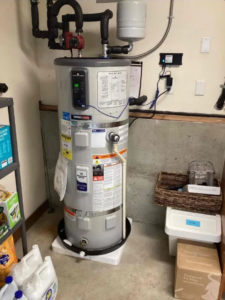
An ENERGY STAR certified heat pump water heater installed by our team, with an EnergyGuide label estimating about $132 in yearly energy cost.
Across those seven heat pump water heater installs, total project costs ran from about $5,500 to $10,400. That is a small sample, and the spread reflects extra work such as adding a dedicated electrical circuit, removing an old gas unit, or fitting a recirculation pump. Across all water heater types, project totals had a median near $4,000. For any water heater, we give you an exact price before we start, so you always know what to expect.
We install a heat pump model when it genuinely fits the home, and we say so plainly when a standard tank is the better value. That honest approach is a big part of why we have earned more than 7,000 Google reviews at a 4.9 average rating across the South Sound.
Example From a Recent Service Visit
A homeowner in Fircrest was replacing an aging gas water heater in the garage and wanted to lower long-term energy use. During the visit we confirmed the garage had the open space and warm air a heat pump water heater needs, and we identified that a dedicated electrical circuit would be required.
Solution:
We coordinated the electrical work, installed the new heat pump water heater in the Fircrest garage as a full-day project, and handled the permit and old-unit removal so the homeowner did not have to.
Here is what Leslie in Tacoma had to say after a recent water heater installation:
“Professional, friendly, efficient, knowledgeable service and conveniently scheduled. Jacob did an outstanding job!”
Leslie in Tacoma
You can read more homeowner experiences on our customer testimonials page, or learn about our full lineup on the water heater services page. Club members also get priority scheduling and annual attention through our Peace of Mind Club, which helps any water heater last longer.
FAQ: Common questions about water heater installs
-
-
Across the seven heat pump water heater installations in our recent service records, total project costs ran from about $5,500 to $10,400. The spread reflects added work like a new electrical circuit or removing an old gas unit. A standard tank replacement usually costs less. We give you an exact price before any work begins.
-
-
Usually yes, especially if you are replacing an electric resistance tank. A heat pump water heater uses roughly 60 to 70 percent less energy to heat the same water, which often saves a typical household a few hundred dollars a year. The exact savings depend on your electric rate and what you are replacing.
-
-
For the right home they are worth it, and the savings are real, not hype. They cost more upfront but use far less energy, so they pay back over time. They are not the best fit for tight closets or homes on gas with low rates. We will tell you honestly if a standard tank is the better value for your situation.
-
-
-
-
A heat pump water heater install is often a full-day job, and several units need a dedicated 240-volt circuit, which may bring in an electrician. Because of that, it is best to plan ahead rather than count on a same-day swap. A standard tank replacement is usually faster and can sometimes be completed same day.
-
-
Still not sure which system is right for your home?
Tell us what your system is doing and we’ll help you figure out the right next step. Pacific Heating & Cooling has been diagnosing heating and cooling problems across Tacoma and the South Sound since 1984. NATE-certified technicians, 2-hour arrival windows, and upfront pricing before any work begins.
No Surprises. Just Solutions.